Kaushik Basu
It feels strange to have known a country since its birth. For much of 1971, Bangladesh (then East Pakistan) was engaged in a war for independence. With US President Richard Nixon standing firmly behind Pakistan as President Yahya Khan’s army tried to crush the independence movement by resorting to rape and genocide, millions of Bangladeshi refugees poured into India. I was then an undergraduate in Delhi and joined a team of students to work in the sprawling refugee camps that had sprung up in West Bengal and Odisha.


Full-fledged aerial war with Pakistan broke out on December 2. I vividly remember catching the night train in Kolkata to return to college during a curfew, under orders to keep all the lights off in the compartment.
This was the high point of Indian Prime Minister Indira Gandhi’s career. She had opened India’s doors to the refugees and intervened militarily to support Bangladesh, refusing to cave into US pressure, which included sending the Seventh Fleet into the Bay of Bengal. Khan’s army surrendered to an Indian-Bangladeshi allied force on December 16, 1971. Bangladesh had already declared independence on March 26, but it was effectively born that day in December.
At independence, Bangladesh was one of South Asia’s poorest countries – poorer than India, and much poorer than Pakistan. Described by then-US National Security Adviser Henry Kissinger as a “basket case,” it floundered for several years, a vast archipelago of poverty and deprivation. Things got worse in 1974, when the Nixon administration suddenly cut off food aid to Bangladesh while the country was in the midst of a famine, on the grounds that it was earning some money by exporting jute bags to Cuba.
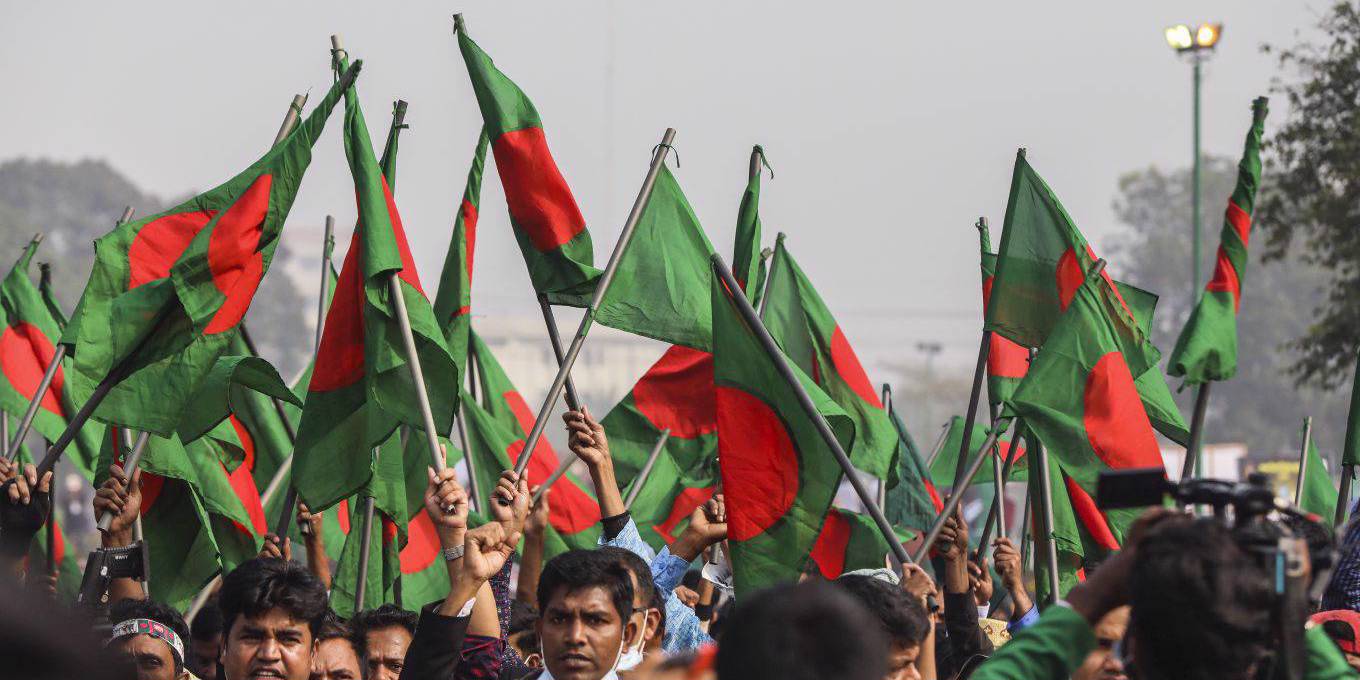
Today, as Bangladesh celebrates a half-century of independence, the country has become a case study in economic development that few would have predicted. When its GDP growth rate surpassed Pakistan’s in 2006, many dismissed it as a one-off fluke. But Bangladesh has outpaced Pakistan every year since then, and – astonishingly – is now one of the world’s fastest-growing economies.
Bangladesh’s GDP per capita now closely rivals India’s and significantly exceeds that of Pakistan. Average life expectancy, at 74, is higher than in India (70) and Pakistan (68). The country is a leading global exporter of ready-made garments, and other sectors are taking off, too. Bangladesh’s pharmaceutical industry, for example, is thriving. With 300 companies (several of which conduct research) the country now meets 97% of domestic demand, and is beginning to export globally.
True, Bangladesh still has much poverty and hardship, rising inequality, and an uncertain future trajectory. Climate change and rising sea levels continue to pose significant dangers, and political instability could yet re-emerge and disrupt economic progress.
Nevertheless, Bangladesh’s remarkable economic transformation – the World Bank now classifies it as a lower-middle-income economy – deserves praise and can offer important lessons for today’s low-income countries.
Bangladesh’s rise is a story of both deliberate interventions and chance. The country owes a large part of its success to progressive NGOs, most notably Fazle Hasan Abed’s BRAC and Muhammad Yunus’s Grameen Bank. One particular intervention that played a larger role than anyone expected was Grameen Bank’s early decision that microfinance credits would go to the senior female member of the household. I have argued elsewhere that this gave women greater voice in the home, which in turn helped divert household expenditure toward child welfare. This is one of the main reasons why Bangladesh has made strong progress on development indicators such as life expectancy and literacy, and in combating malnutrition.
Bangladesh has one of the world’s largest microfinance sectors, which has enabled households to break out of the debt trap and start their own small businesses. Using a computable general equilibrium model, Selim Raihan, SR Osmani, and MA Baqui Khalily have shown that microfinance did more than just help the households that received money. By bolstering fiscal and monetary policies, it boosted the country’s GDP by 9-12%.
But Bangladesh’s success has also had a lot to do with luck. The Indian subcontinent has complex labor laws, notably the Industrial Disputes Act, which predates Indian and Pakistani independence in 1947, and has thwarted the emergence of large manufacturing firms able to realize economies of scale. Pakistan repealed the law in 1958, but for the wrong reasons, to enable big corporations to control workers. Moreover, it did so in a ham-handed way, thereby contributing to labor exploitation and crony capitalism.
Bangladesh, having once been part of Pakistan, was born without the law’s baggage. But, unlike Pakistan, the country went on to develop its own labor regulations that were flexible without giving corporations unfettered power. This played an important role in Bangladesh becoming a successful global manufacturing hub.
Finally, a crucial political factor underpins Bangladesh’s economic success. Prime Minister Sheikh Hasina has often been criticized, but she has made one essential contribution to the country’s upward trajectory. Although Bangladesh’s constitution guarantees religious freedom, it has been challenged by fundamentalist groups that renounce what the prominent Bangladeshi commentator Abul Barkat has described as the “liberal and humanistic origin of Islam in East Bengal.” Sheikh Hasina, who is reputed to be innately secular, has kept these destructive forces at bay.
Many countries have succumbed to religious fundamentalism, with disastrous consequences for their economies. Bangladesh is notable for having withstood this danger. Its buoyant, vibrant economy, now with a 50-year track record, is testimony to this success.
The writer, a former chief economist of the World Bank and chief economic adviser to the Government of India, is Professor of Economics at Cornell University and Nonresident Senior Fellow at the Brookings Institution. ©Project Syndicate.