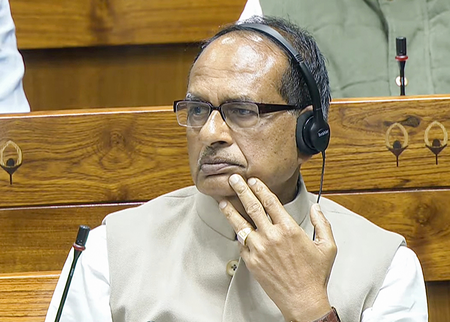
New Delhi: Union Minister for Agriculture and Rural Development Shivraj Singh Chouhan is set to deliver the government’s reply on the Viksit Bharat – Guarantee for Rozgar and Ajeevika Mission (Gramin) Bill, 2025 (VB-G RAM-G Bill) Thursday.
The Bill, which proposes replacing the longstanding Mahatma Gandhi National Rural Employment Guarantee Act (MGNREGA) with a new framework guaranteeing 125 days of wage employment annually to rural households, concluded its discussion phase Wednesday.

Critics from the opposition argued that it could weaken demand-driven job guarantees and shift financial burdens to states, while supporters hail it as a modern, convergence-focused approach aligned with the ‘Viksit Bharat @2047’ vision, emphasising infrastructure like water security and rural livelihoods.
The Lower House will also hold a dedicated discussion under Rule 193 on the escalating air pollution crisis in Delhi-NCR, a topic raised by MPs, including Priyanka Gandhi Vadra (Congress), Kanimozhi Karunanidhi (DMK), and Bansuri Swaraj (BJP).
With Delhi’s air quality frequently dipping into hazardous levels this winter, lawmakers are expected to debate mitigation measures, public health impacts, and inter-state coordination.
Wednesday marked significant progress on other fronts. The Lok Sabha passed the Sustainable Harnessing and Advancement of Nuclear Energy for Transforming India (SHANTI) Bill, 2025, introduced by Minister Jitendra Singh.
The legislation paves the way for private sector participation in nuclear power generation, establishes a pragmatic civil liability regime, and grants statutory status to the Atomic Energy Regulatory Board.
Proponents assert it will accelerate India’s goal of 100 GW nuclear capacity by 2047, bolstering clean energy security amid rising demands from data centres and industry.
In the Rajya Sabha, the Sabka Bima Sabki Raksha (Amendment of Insurance Laws) Bill, 2025, cleared Wednesday, allows 100 per cent Foreign Direct Investment in the insurance sector — up from 74 per cent.
The Upper House also passed the Repealing and Amending Bill, scrapping 71 obsolete laws. These moves are projected to attract global capital, enhance insurance penetration, and achieve ‘Insurance for All’ by 2047.