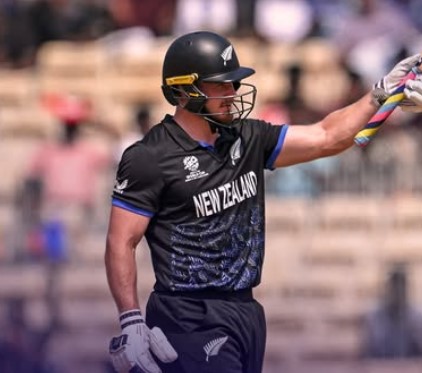
Chennai: Glenn Phillips was back at his best blasting the fastest fifty for New Zealand in T20 World Cup history as he and Rachin Ravindra struck fluent half-centuries to power them to an eight-wicket win over Canada and seal their Super 8s berth from Group D Tuesday.
In a must-win contest for both teams, Canada, opting to bat, were powered by Yuvraj Samra’s record-breaking 110, the youngest century-maker in T20 World Cup history, but the 146-run unbroken Rachin-Phillips stand and an undisciplined bowling effort ultimately overshadowed the milestone knock.


Chasing 174, New Zealand rode on Rachin and Phillips’ stand that came off just 73 balls, overhauling the target in 15.1 overs.
Phillips remained unbeaten on 76 from 36 balls with six sixes and four fours, while Rachin was 59 not out from 39 balls (4×4, 3×6) in their statement win.
The Kiwis finished their league campaign with six points and a net run rate of 1.227.
Having already qualified, South Africa lead the group on net run rate and face UAE in their last league match.
Canada remains winless after three matches and next faces Afghanistan in their final league fixture.
Canada struck early after a wayward opening over from Jaskaran Singh cost 14 runs, including a wide and a no-ball.
Finn Allen (21 off 8) counter-attacked before falling to a stunning diving catch by Shivam Sharma, while Tim Seifert departed soon after as New Zealand slipped to 30 for 2 in 3.1 overs.
However, Rachin and Phillips quickly turned the tide as New Zealand raced to 60 for 2 in the powerplay as Rachin cut and drove with authority, including a six over deep point and two boundaries in a 15-run fifth over.
Phillips, who was five off four balls at one stage, shifted gears after the power play.
He struck Saad Bin Zafar for consecutive boundaries — a sweep and a back-foot cut — before launching skipper Dilpreet Bajwa over long-off for six.
He then cleared Ansh Patel straight down the ground and followed it up with another maximum to move to 39 off 19 balls.
The right-hander brought up a 22-ball fifty in style, hammering Patel for a straight six and then pulling one over deep midwicket.
He continued the assault in the 13th over, hitting Zafar for two sixes, including a switch-hit over deep midwicket.
The partnership reached its fifty in just 30 balls as New Zealand powered to 106 for 2 at the halfway mark.
Rachin meanwhile, completed his half-century off 35 balls, smoking Shivam Sharma over deep midwicket for a six, before pulling Jaskaran through midwicket to seal the chase with 29 balls to spare.
Earlier, the left-hander Samra, who is named after India’s World Cup-winning hero Yuvraj Singh, scripted his own chapter with a 58-ball hundred, adding to his earlier feat of being the youngest to score a fifty in the tournament at 19 years and 141 days.
He is also the third Canadian to register a half-century in this edition.
Samra smashed six sixes and 11 fours in his 65-ball knock, taking full advantage of a depleted New Zealand attack minus Lockie Ferguson (personal leave) and Mitchell Santner (indisposed).
He set the tone early, taking on pace spearhead Matt Henry in the opening over with back-to-back fours.
He then shifted gears in the final over of the powerplay, hammering James Neesham for 18 runs.
After two dot balls, he unleashed a sequence of 4, 4, 4, 6 — pulling behind square, muscling one over mid-wicket, drilling a straight drive and finishing with a stunning upper-cut over point — to race to 29 off 17 balls.
Samra brought up his fifty off just 36 balls and found solid support from skipper Dilpreet Bajwa as the duo stitched together a 116-run opening stand — the highest first-wicket partnership by an Associate team against a Full Member in men’s T20 World Cups.
Bajwa was clearly overshadowed and got out for 36 off 39 balls.
Samra also had luck on his side, dropped on 91 when Henry failed to hold on at deep extra cover and again on 107 off Neesham.
However, New Zealand found some relief in the final three overs, conceding just 23 runs and picking up two wickets to deny Canada a 180-plus total.