Bertrand Badré & Saurabh Mishra
For most of the postwar era, global power was defined by alliances, aircraft carriers, and reserve currencies. But we are now entering an era defined by critical infrastructure and those who finance, build, and operate it. Ports, power grids, rail corridors, data centres, and critical-mineral supply chains are no longer just “projects.” They are the operating system of sovereignty. Infrastructure— networks that move energy, goods, and data—is the industry of industries. Whoever shapes it through contracts, standards, currency denomination, and long-term maintenance (much of which is increasingly guided by data and AI-driven systems) will achieve enduring global influence.


Debates about “de-dollarization” often focus on reserve currencies. In the IMF’s Currency Composition of Official Foreign Exchange Reserves data, the US dollar accounted for roughly 57% of global reserves in 2025, with the euro a distant second. But official reserves are a lagging indicator. The more relevant shift concerns infrastructure. China recognised this early. Between 2000 and 2023, it extended approximately $2.2 trillion in official loans and grants as part of its Belt and Road Initiative, much of which was invested in transportation and energy infrastructure. This model was never just about capital. By bundling finance, contractors, equipment, and digital systems, China was exporting state capacity and embedding long-term dependence. Projects like the Chancay mega-port in Peru—which is majority-owned by a Chinese operator and backed by billions in investment—illustrate how infrastructure can reconfigure trade routes and other dependencies.
Likewise, the Addis Ababa–Dji bouti Railway, financed largely by Chinese lending, dramatically reduced freight times between Ethiopia and the Red Sea. The geopolitical implications of infrastructure investment are increasingly top of mind for policymakers. The prospect of Chinese involvement in airport construction in Greenland raised security concerns in both Denmark and the US. The new contest is not simply between currencies but between competing infrastructure blocs. For decades, US influence rested on military power, the dollar, and multilateral institutions. But while this architecture still matters, it is rapidly being supplemented—and in some cases challenged—by infrastructure strategies. Political tensions reflect this shift.
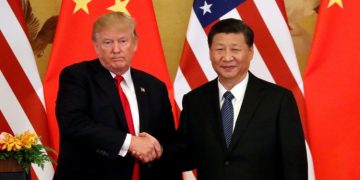
In 2024, US President-elect Donald Trump threatened severe tariffs against countries pursuing alternatives to dollar-based invoicing and payments. At the same time, Western economies have scaled up their own infrastructure initiatives. The G7’s Partnership for Global Infrastructure and Investment, for example, aims to mobilize $600 billion by 2027; the European Union’s Global Gateway pledges up to 300 billion ($353 billion); and the Blue Dot Network (launched by Australia, Japan, and the US) seeks to certify high-quality infrastructure standards. Yet many countries perceive these efforts as slow and overly conditional.
In a world facing climate shocks, demographic pressures, and urgent development needs, the ability to deliver infrastructure quickly often outweighs governance concerns. Various middle powers are redefining their own strategies accordingly. India, for example, is pursuing “corridor diplomacy” by supporting projects like the Chabahar Port and the India Middle East–Europe Economic Corridor. Rather than aligning exclusively with one bloc, it is leveraging infrastructure to hedge, diversify, and expand its own strategic autonomy. There is also another critical shift underway. Far from being confi ned to steel and concrete, infrastructure geopolitics increasingly extends into compute, data, and AI. Corporate filings reveal the scale of this transition. Technology firms such as Microsoft, Alphabet, Meta, and Amazon are investing tens of billions of dollars annually in AI infrastructure, including data centers and specialized hardware. Their capital expenditures and associated depreciation now resemble those of traditional infrastructure sectors. Semiconductor manufacturing has become a strategic chokepoint in this system. Facilities costing tens of billions of dollars anchor global supply chains and define access to advanced compute capabilities. But AI is not just another layer of infrastructure. It is meta-infrastructure that will shape how all other systems are planned, operated, and optimized. If infrastructure defines geopolitical power, AI is increasingly defining infrastructure. It can improve grid efficiency, extend the life of transport networks, and enable more precise climate-adaptation strategies. But AI also introduces new forms of vulnerability. Remote control over optimization systems can function as a “kill switch” for critical infrastructure, and opaque or biased algorithms can systematically determine which regions or communities receive investment.
In this context, infrastructure is no longer only about physical assets, but also about who controls the intelligence layer that governs them. Nowhere are the stakes more visible than in Gaza. According to UN and World Bank assessments, by late 2025, roughly 90% of homes and infrastructure had been damaged or destroyed, and nearly the entire population of 2.1 million people had been displaced. Reconstruction will require tens of billions of dollars, but without a durable political settlement, the enclave’s new infrastructure could become an instrument of control rather than recovery. Infrastructure geo-politics is not inherently emancipatory. Transit corridors, energy systems, and housing can be designed to enable mobility and growth, but they can also be used to constrain people. The world is moving toward overlapping infrastructure ecosystems: a US-centred system built on open capital markets and legal enforcement; a China-centred system combining state finance, contractors, and embedded standards; and a diverse set of regional and middle-power strategies. The decisive question is not which system is largest, but which will ultimately be accepted as the default. George Orwell famously warned about the control of language.
Today, we are witnessing an even more subtle form of power. Infrastructure, increasingly guided by algorithmic systems, risks making certain potential futures appear inevitable, and others unthinkable. The greatest danger is not that one power dominates, but that societies gradually lose the ability to choose among competing paths. The new world order is being built in concrete and encoded in silicon. The last sovereign act may not be to build or to resist, but to recognise that these choices remain open, before the systems we construct begin to optimise us in return.
Bertrand Badré is Chair of the Project Syndicate Advisory Board. Saurabh Mishra is Founder and CEO of Taiy .AI.
Orissa POST – Odisha’s No.1 English Daily