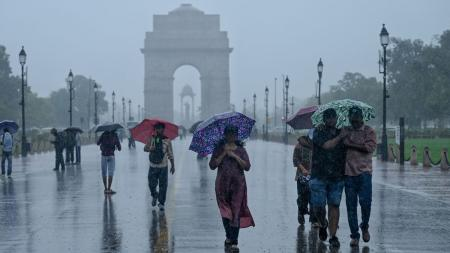
India is not running out of rain; it is becoming increasingly vulnerable to running out of usable water. At first glance, the statement appears contradictory. Nearly 80% of the country’s annual rainfall arrives during the Indian Summer Monsoon (ISM) between June and September. Yet every year, the same monsoon that replenishes rivers and reservoirs also leaves behind flooded cities, prolonged dry spells, depleted groundwater, and growing concerns over water availability. This contradiction is what we call the Indian Monsoon Paradox.
The challenge before India is no longer simply whether enough rain falls, but whether that rain can be captured, stored, and used when and where it is needed. Water security underpins agriculture, drinking water, sanitation, ecosystems, hydropower, and industrial development. In many ways, it forms the backbone of India’s water economy.


India’s water economy rests on three interconnected pillars: sources, storage, and demand. Water enters the system primarily through the ISM, supplemented by pre-monsoon thunderstorms, post-monsoon rainfall, the Northeast Monsoon over southern India, and glacier-fed river systems. Storage comprises reservoirs, lakes, ponds, wetlands, groundwater aquifers, glaciers, and even soil moisture. Demand includes agriculture, households, industries, energy production, and ecosystems. Water security depends not merely on how much water enters the system, but on how effectively it is stored, managed, and allocated throughout the year. Among these pillars, the monsoon remains the dominant source. It sustains the freshwater requirements of more than 1.4 billion people, supports nearly half of India’s cultivated land, replenishes reservoirs and aquifers, and feeds perennial rivers such as the Ganga, Brahmaputra, and Indus. A deficient monsoon immediately affects crop production, food prices, drinking water supplies, hydropower generation, and industrial activity. Therefore, the monsoon is much more than a season, it is an economic lifeline and a measure of the country’s well-being.
Understanding this paradox requires understanding the monsoon itself. The ISM is among the world’s oldest and most sophisticated climate systems, having evolved over millions of years. However, it has never been constant. The year-to-year fluctuations in seasonal rainfall known as interannual variability have long been influenced by natural climate drivers such as the El Niño Southern Oscillation, El Niño Modoki, and the Indian Ocean Dipole. These large-scale climate phenomena alter atmospheric circulation, moisture transport, and monsoon dynamics, enabling agencies such as the India Meteorological Department (IMD) to produce seasonal forecasts using increasingly sophisticated climate models. Simultaneously, climate change is adding another layer of complexity. A warmer atmosphere can hold more moisture, increasing the likelihood of intense rainfall events. Multiple observational studies indicate that heavy rainfall events across India have become both more frequent and more intense over recent decades. Increasingly, the monsoon is characterised by fewer rainy days interspersed with short episodes of exceptionally heavy rainfall and longer dry spells.
The seasonal rainfall total may appear close to normal, yet its distribution in time and space is becoming increasingly erratic. Rain that falls in a few intense bursts is far less effective at replenishing groundwater than rain spread steadily over several weeks. Instead, much of the excess water rapidly flows into rivers and eventually the sea, while cities flood and reservoirs spill over. Months later, the same regions often face groundwater depletion and water scarcity. In other words, more rain does not necessarily translate into more usable water.
India has already recognised the importance of strengthening water security. Programmes such as “Mission Kakatiya” in Telangana have demonstrated how restoring traditional tanks can improve irrigation and groundwater recharge. Similarly, the Government of India’s Jal Shakti Abhiyan and the nationwide “Catch the Rain” campaign have promoted rainwater harvesting, watershed development, restoration of water bodies, and afforestation. These initiatives represent important steps in the right direction. Their long-term success, however, should be evaluated not only by the number of projects completed but also by measurable improvements in groundwater levels, reservoir resilience, water-use efficiency, and the livelihoods of communities they serve.
Ultimately, India’s water future cannot depend solely on receiving a “normal” monsoon. It must depend on building a climate-resilient water management system capable of coping with increasing variability and extremes. That requires integrating climate science with water policy, modernising reservoir operations, expanding groundwater recharge, restoring wetlands, improving urban drainage, and strengthening seasonal and sub-seasonal forecasting.
The ISM has sustained civilisations across the subcontinent for millennia. It remains India’s greatest natural asset, but climate change is making that asset increasingly unpredictable. The challenge before us is no longer simply to pray for a good monsoon; it is to prepare for a different one. India’s future water security will depend not only on how much rain falls, but on how wisely the nation captures, stores, and manages every drop. The Indian Monsoon Paradox is therefore not merely a scientific puzzle; it is one of the defining policy challenges of the twenty-first century.
Hemadri Bhusan Amat is Project Scientist, IMD (HQ), New Delhi. Adarsh Dube is Project Scientist, IMD, Pune.