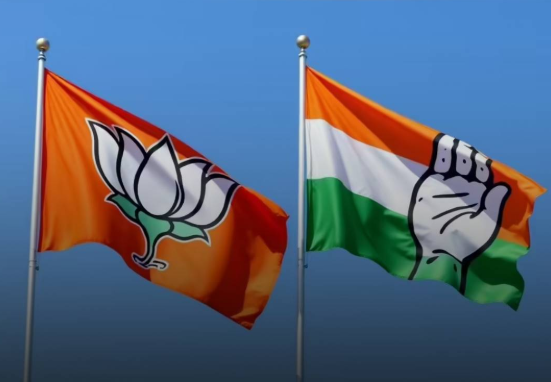
The BJP and the Congress seem to believe that they are going to reap rich political dividends through their conflicting positions on the singing of the national song Vande Mataram. Ground reality shows the vast majority of population are concerned about growing inequalities, unemployment, shabby educational infrastructure, corruption in education and recruitment systems, rising prices and a grave economic crisis despite the government’s claims about phenomenal economic growth during the past 12 years.
Truth is both the ruling party and the Opposition are facing a formidable challenge from conscious youths and students, comprising nearly 65 per cent of the population. The government has no answers to questions the youth have raised about the appalling lack of accountability on every area of governance.
Also Read


Hence, the BJP seems to have found in the Vande Mataram controversy a convenient ploy to divert attention from important issues affecting the people and also return to its core agenda of communal divide. The party is trying to whip up public sentiments over the Congress’ advocacy of singing only the first two stanzas of the song approved by the Constituent Assembly. The song was first publicly sung by Rabindranath Tagore.
However, in 1937, the Indian National Congress, on the suggestion of Tagore and Mahatma Gandhi, adopted the first two stanzas of the song. The issue got reignited after Congress leaders sang only the first two stanzas of the national song at a party event, prompting the BJP to accuse the Opposition party of disrespecting the song.
One may recollect the visuals of Sonia Gandhi fretting over singing of the national song recently at the Congress party office during Independence Day celebrations. Congress president Mallikarjun Kharge has defended the shorter rendition, arguing that it was the version historically sung by leaders including Mahatma Gandhi, Jawaharlal Nehru and Sardar Vallabhbhai Patel.
The controversy goes back nearly nine decades to a debate over the song’s religious imagery, national identity and the accommodation of India’s diverse communities. The dispute has got a fresh lease of life following the Centre’s 2026 protocol around the full six-stanza version and the year-long commemoration of 150 years of Vande Mataram.
The Parliament also passed the Prevention of Insults to National Honour (Amendment) Act, 2026, during the recent Monsoon Session. The legislation criminalises attempts to stop or prevent the singing of Vande Mataram. Vande Mataram was written by Bankim Chandra Chattopadhyay and first appeared as part of his novel Anandamath.
The song became one of the most powerful symbols of India’s freedom movement. The first two stanzas were originally composed as a hymn to the motherland, while the poem was later expanded in the context of Bankim Chandra Chattopadhyay’s novel Anandamath. The later verses introduced explicitly Hindoo religious imagery, including references associated with deity worship.
Prime Minister Narendra Modi has repeatedly criticised the 1937 decision. During the special discussion in Parliament marking 150 years of Vande Mataram, Modi argued that the Congress had “fragmented” the song under pressure from the Muslim League.
He linked the controversy to the wider political debate over Congress’ approach to communal harmony before Independence. The way the top brass of the government, including the PM and Union Home Minister Amit Shah, are rejecting the two-stanza version of the song, it appears they are trying to project themselves as bigger nationalists, patriots and more sagacious than Mahatma Gandhi, Rabindranath Tagore, Subhash Bose, Vallabhbhai Patel and Jawaharlal Nehru.
They are conveniently omitting revealing to the young generation and millions of uneducated citizens that the Constituent Assembly had adopted the two-stanza Vande Mataram as the national song. It has been changed to six stanzas simply by a Home Ministry order signed by a joint secretary. It amounts to belittling the Constitution-makers.
The debate over the supposed disrespect to the national song and the Congress’ response show how the mainstream political parties are intentionally ignoring more pertinent issues like skyrocketing prices of fuel and essential commodities. This is not selective amnesia, but a calculated move to sweep under the carpet the monumental economic and educational crises the nation is facing about which students and youths are becoming increasingly vocal.
It also goes to show how both BJP and Congress fail to take up people’s issues at a core level, revealing more similarities in intent for the nation than they would like to reveal. The main goal for both parties is to win elections, as it should be for any political party. But at the core, they do not seem very different from each other.
Communal play, whether it be majority or minority appeasement has always been a major factor for both parties. Several states will go to polls in 2027, while the next Lok Sabha elections are due in 2029. The BJP’s failure to impress has been exposed by the agitation of the students and youths at Jantar Mantar. It is desperately trying to reconnect with the youth who seem determined not to be hoodwinked by binary politics.
The BJP is hoping against hope to retain its support base by going back to its core agenda of religious divide, the seeds of which are found in good measure in the national song controversy. It is time the ruling party and the principal opposition party mend their ways and think of development for the nation. Failing that, both may become irrelevant to the new altered India that seems to be on the roll now.