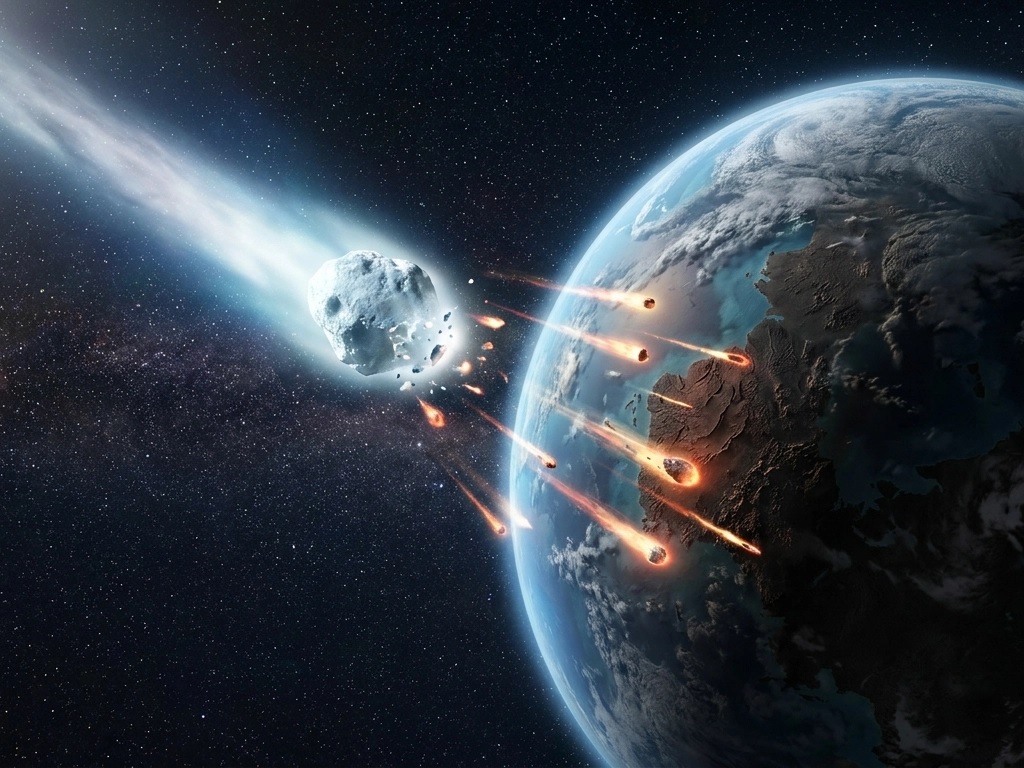
New computer simulations are challenging a decades-old scientific theory that comets played a crucial role in kick-starting life on Earth billions of years ago.
The findings suggest that fragile organic molecules carried by these icy space objects may have been destroyed upon impact, potentially overturning a long-standing explanation for how life’s essential ingredients first arrived on our planet.


The idea that comets delivered the building blocks of life dates back to at least 1961, while the broader concept of panspermia — the theory that life’s ingredients arrived from space — was scientifically proposed in 1908.
Life on Earth depends on complex organic mole cules, but scientists remain uncertain whether the early planet had sufficient raw materials for prebiotic chemistry, the chemical reactions that produce life’s building blocks.
Comets, often called “dirty snow balls” because they contain dust and ice, also carry organic compounds.
This has led scientists to believe that they may have supplied early Earth with water and essential molecules needed for life to emerge.
However, a new study published in Scientific Reports questions this theory.
Researchers estimate that early Earth may have experienced intense bombardment more than 4 billion years ago, involving over 100,000 comets larger than 100 metres (328 feet).
But most impacts may have been too violent for delicate organic molecules to survive.
To investigate this possibility, researchers used advanced models of comet formation and evolution to simulate early Earth’s conditions 100,000 times.
“Given what we know about surface environments on the early Earth, on average, our simulations found that there were no successful impacts,” said lead study author Richard Anslow, who conducted the research during his doctorate at the University of Cambridge.
The simulations showed that 54% of scenarios involved no impacts, while the remaining 46% recorded at least one collision.
Only a tiny minority produced up to three impacts.
According to Anslow, comets were travelling too fast to deliver organic molecules intact, making them less useful for prebiotic chemistry than previously believed.
The researchers have not completely ruled out the possibility of a successful delivery.
However, such an event would have required exceptionally favourable conditions, including a suitable impact location, liquid water and other essential chemicals.
The study specifically examined hydrogen cyanide (HCN), a naturally occurring compound detected in dozens of comets, including Hal ley’s Comet and Comet Hale Bopp.
Containing hydrogen, carbon and nitrogen, HCN is an important precursor in prebiotic chemistry.
When combined with water, it can contribute to the formation of amino acids, the molecules that make up proteins.
Previous research has identified hydrogen cyanide as a potentially crucial ingredient in the origin of life.
While the findings challenge the idea that comets supplied Earth’s earliest life-building materials, researchers say a rare successful impact cannot be entirely ruled out.
The results instead raise fresh questions about how our planet acquired the chemical ingredients necessary for life.