New Delhi: Indian and Chinese armies held high-level talks this month in the Arunachal Pradesh sector focusing on border management and addressing outstanding issues along the Line of Actual Control (LAC), the Ministry of External Affairs (MEA) said Wednesday.
The talks, believed to have spread over a number of days, were held amid reports of aggressive military posturing by Chinese troops along the frontier, especially in the Upper Subansiri region of Arunachal Pradesh.

In September too, the senior military commanders of the two armies were engaged in flag talks in two sessions on both sides of the frontier in the Arunachal Pradesh sector.
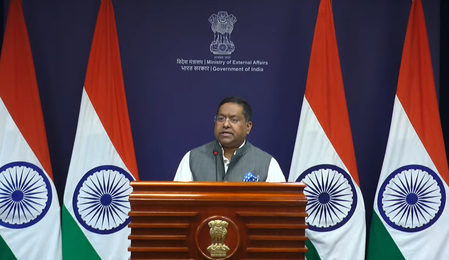
“India and China engage regularly through diplomatic and military mechanisms and you are well aware of those mechanisms,” MEA spokesperson Randhir Jaiswal said at his regular media briefing while responding to a question.
“A meeting of the senior military commanders was held in the eastern sector recently. Discussions between the two sides focused on improving border management as well as addressing outstanding issues along the LAC,” he said.
Jaiswal said such interactions are aimed at maintaining peace and tranquillity in the border areas and preventing any escalation.
Lt Gen Girish Kalia, General Officer Commanding of the Army’s III Corps headquartered near Dimapur in Nagaland, led the Indian delegation at the talks in the second week of this month, while the Chinese side was led by his counterpart.
In the military and diplomatic talks, India has been conveying to the Chinese side the importance of maintaining peace and tranquillity in the frontier regions for the continued development and progress of the overall bilateral relationship.
In the last one-and-a-half years, the two sides have taken a series of measures to rebuild their relationship after it came under severe strain following the deadly Galwan Valley clashes in eastern Ladakh in 2020.
Nearly 50,000 troops of the Indian Army are deployed in various mountainous locations in eastern Ladakh as multiple rounds of talks between the two sides have not yielded concrete outcome to de-escalate the situation.
China has also deployed an equal number of troops, according to officials.
Following the eastern Ladakh standoff last year, India has bolstered its overall military preparedness along the LAC in the Arunachal Pradesh sector as well.
Jaiswal also responded to a question on a report that said Chinese satellite data may have been used by Pakistan to monitor the movements of Indian troops and keep an eye on military installations during Operation Sindoor.
“We have seen some media reports on this particular issue. We will continue to closely follow the developments which may have a bearing on our security interest and we take appropriate measures,” he said.
The new report on the Chinese satellite data came at a time New Delhi and Beijing are looking at normalising the ties that saw a major downturn during the over four-year military standoff in eastern Ladakh.
In October 2024, the two sides firmed up a disengagement pact for Depsang and Demchok, the last two friction points in eastern Ladakh.
Days after the agreement was finalised, Prime Minister Narendra Modi and Chinese President Xi Jinping held talks in Kazan and took a number of decisions to improve the ties.
In August last year, Modi travelled to the Chinese city of Tianjin to attend the annual SCO summit. Modi and Xi held extensive talks on the sidelines of the SCO (Shanghai Cooperation Organisation) summit.
In the meeting, Modi said India is committed to taking forward its ties with China based on mutual trust, respect and sensitivity.
In September, Modi held bilateral talks with Xi on the margins of the BRICS summit in New Delhi.
In the talks, Modi stressed that both sides must show sensitivity to each other’s core issues and let relations be guided by the “three mutuals” — mutual respect, mutual sensitivity, and mutual interest.