
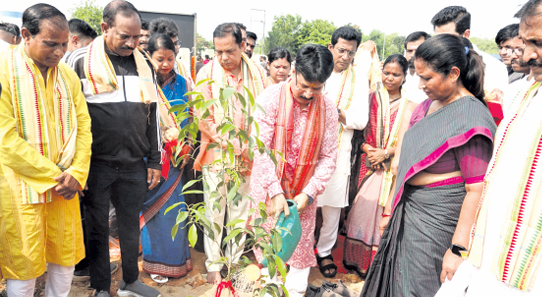
Bhubaneswar: The Bhubaneswar Municipal Corporation (BMC) has set an ambitious target of creating 10 Miyawaki forests and planting 60,000 trees across the City during the 2026-27 financial year, Housing and Urban Development Minister Krushna Chandra Mahapatra said Friday.
Inaugurating the City’s first Miyawaki forest of the year at Hatiasuni, Mahapatra said, “As part of its ongoing efforts to make Bhubaneswar greener, cleaner and more climate-resil ient, the BMC has set a target of creating 10 such forests and planting as many as 60,000 trees during FY27.”
The minister said more than 75,000 trees had been planted at 15 locations over the past two years using the Miyawa ki method. These plantations have since developed into dense urban forests, with many trees growing beyond 10 feet in height.
He said Miyawaki plantations are also being developed at several locations across the City, including Nagar Van, the open space near APJ School in Ghatikia, Nayapalli Hajj Ground, Kalinga Nagar K-6 and areas near Kalinga Studio. The initiative is being implemented by the BMC in collaboration with the City Forest Division and Chandaka Forest Division.
Highlighting the growing challenge of climate change, Mahapatra said large-scale tree plantation remains one of the most effective ways to combat rising temperatures and environmental degradation. He noted that emissions from vehicles and the increasing use of air conditioners are contributing to air pollution and related health problems.
“Trees are the most effective natural solution to absorb pollutants and improve air quali ty,” he said. The minister also expressed satisfaction that Bhubaneswar currently ranks fourth in the country for air quality and urged citizens to work collectively to help the City secure the top position. As part of the plantation drive, around 3,000 saplings were planted at the Hatiasuni Miyawaki site.
Simultaneously, another plantation programme was conducted around a waterbody in Prachi Vihar under Ward 18, where Mayor Sulochana Das attended as the chief guest. BMC officials said all arrangements have been made for planting 60,000 trees in FY27 with the support of the Forest Department.
Das emphasised that civic authorities alone cannot achieve the City’s green goals without active public participation. She appealed to citizens to plant and nurture trees in available open spaces and urged every resident to plant at least one tree under the ‘Ek Ped Maa Ke Naam’ campaign. “If every citizen plants and cares for at least five trees during their lifetime, it will significantly improve air quality and ensure a healthier environment for future generations,” she said.
BMC Commissioner Chanchal Rana said the Miyawaki technique allows significantly higher tree density than conventional plantation methods. While conventional forestry accommodates around 1,600 trees per hectare, the Miyawaki method enables the plantation of 8,000 to 10,000 trees per hectare — nearly five times more.
The method involves planting native species in close proximity, enabling rapid growth and the creation of self-sustaining dense forests that require minimal maintenance.
The plantations include around 24 indigenous species, such as neem, mango and jackfruit, suited to the local climate.