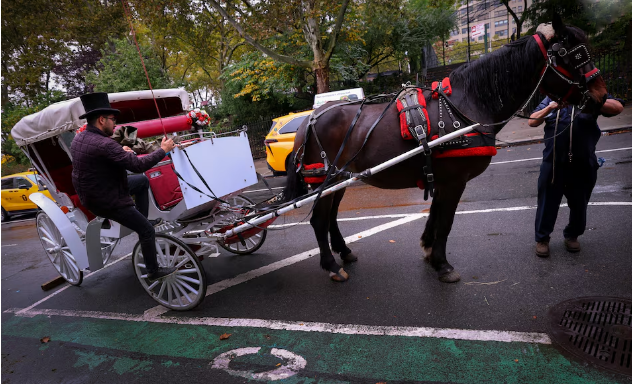
New York: The horse-drawn carriages driven by coachmen in black top hats through Central Park and nearby Manhattan streets, which long seemed like 19th-century relics, may soon be phased out as New York City lawmakers prepare to vote on a Bill to ban them starting June 1, 2028.
The carriages have rolled through Central Park since the 1800s but more recently have been condemned by animal rights activists, who say the horses are subjected to inhumane and unsafe conditions.


While attempts over the last decade to shut down the industry have failed, a majority of City Council members have co-sponsored the current Bill, which has the support of Mayor Zohran Mamdani. “The horse industry is coming to an end,” he said earlier this month.
Carriages have traversed Central Park since a 6-mile loop was designed for horse rides in the 1800s. By the mid-20th century, the city had limited horse-drawn carriage licences to 68
. Carriages were allowed to operate in the park and on city streets alongside cars.
“These carriages have been here before any of us have been here,” said Angelica Vega, a 45-year-old dog walker who has been coming to Central Park for 20 years, often three times a day.
“It’s going to be sad to walk in the park and not see them.”
Support for the proposed ban grew after the death this summer of Romanch Mahajan, an 18-year-old tourist from India.
Mahajan was thrown from a carriage and died June 17 when the horse bolted after the driver stepped away to take a picture of Mahajan’s family.
Mahajan’s family filed a $50 million notice of claim against the city government and expressed support for the ban.
“We welcome the vote that will finally ban horse carriages in New York City so that no other human being or horse has to suffer the terrible tragedy that has befallen the Mahajan family,” Sagar Chadha of Liakas Law, counsel for the Mahajan family, said in a statement.
The ban is expected to put hundreds of people out of work, including carriage owners, drivers and stable workers, and raises questions about the future of their horses.
Ahmet Bilici, 52, grew up on a farm in Turkey and became a carriage driver in 2003, shortly after immigrating to the US.
He later became a business owner.
A driver can earn a six-figure annual income giving rides that cost more than $70 for 20 minutes, and that income can double if the driver owns the business, he said.
“I have a licence issued by the city.
If I’m not doing anything wrong, how can you come and attack my business?” Bilici said as he waited for customers beside his carriage.
The Transport Workers Union also denounced the proposed Bill. “The horses in Central Park are iconic.
We are as much a part of the city as the Statue of Liberty and the Empire State Building,” Christina Hansen, a carriage owner and union shop steward, told the media.