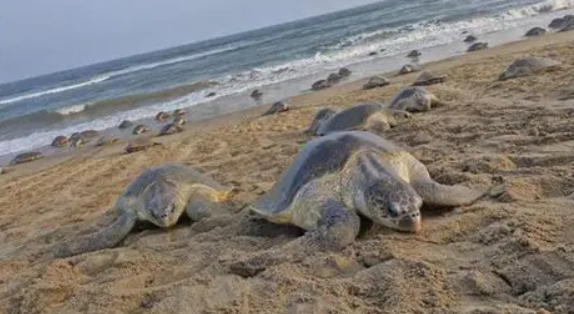
Bhubaneswar: As the world observed World Turtle Day Saturday, concern deepened over the absence of mass nesting by Olive Ridley sea turtles at Odisha’s famed Gahirmatha rookery in Kendrapara district, regarded as the world’s largest nesting ground for the endangered marine species.
The annual spectacle of lakhs of Olive Ridley turtles converging on the Gahirmatha coast for synchronised egg-laying, a phenomenon known as “arribada”, did not occur this year, reviving concerns among conservationists and wildlife experts over changing ecological conditions along Odisha’s coastline.


More than a decade after the turtles skipped the nesting ground in 2014, the marine creatures once again stayed away from their preferred beach this year, leaving experts puzzled over the reasons behind the unusual behaviour.
Questions are now being raised over whether rapid beach erosion, habitat fragmentation, unchecked trawl fishing, increasing human interference, global warming and climatic changes have disrupted the turtles’ nesting pattern. “It’s a unique natural phenomenon. It is difficult to predict what exactly prompted the turtles not to appear for arribada at Gahirmatha this year,” said Varadaraj Gaonkar, Divisional Forest Officer, Rajnagar Mangrove Forest Division (Wildlife).
The Gahirmatha Marine Sanctuary falls under the administrative jurisdiction of the Rajnagar Mangrove Forest Division. Wildlife experts believe several factors may have contributed to the turtles avoiding the nesting beach, though no conclusive scientific explanation has emerged so far.
According to them, intensive trawl fishing operations and growing human activity along the coast may have disturbed the turtles’ habitat during the breeding season. Researchers also point out that the behavioural and habit patterns of Olive Ridleys continue to remain largely unexplained despite years of study.
Also Read : Meet the frontline warriors of state’s turtle conservation efforts
According to environmentalist Hemant Rout, the arribada did not occur at Gahirmatha this year even though offshore con gregations were formed. “Coastal erosion, climate change, illegal fishing, untimely rain and other factors may be the reasons behind the Olive Ridleys skipping Gahirmatha this year.
But we hope the turtles will come again to their favourite nesting site next year,” Rout added. While Odisha’s coastline remains one of the world’s most important nesting habitats for the species, scientists are still unable to fully explain why the turtles prefer specific beaches such as Gahirmatha for mass nesting in certain years while avoiding them in others.
Forest officials noted that turtles had also skipped arribada at Gahirmatha in 2014, 2008, 2002, 1998, 1997, 1988 and 1982. Ironically, the previous nesting season had witnessed an impressive turnout. In 2025, nearly 6.06 lakh Olive Ridley turtles had emerged from the sea to lay eggs along the Odisha coast.
Only female turtles participate in arribada, usually arriving on the beaches late at night to dig pits and lay eggs before silently returning to the sea.
Hatchlings emerge after 45 to 60 days and instinctively make their way towards the ocean without maternal care — one of nature’s rare survival phenomena.
The absence of arribada this year has once again highlighted the fragile balance between marine conservation and mounting environmental pressures along Odisha’s coast, raising fresh concerns over the long-term survival of one of the state’s most celebrated natural heritage events.