
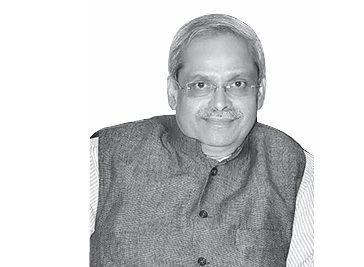
By Parakala Prabhakar
The Opposition parties in India are either naive or we must conclude that they may not be really sincere when they shout about ‘vote chori’. If they indeed believe in what they say about ‘vote chori’ and massive targeted deletions, why are they participating in these fake elections and sitting in legislatures which are elected on the basis of ‘vote chori’ and voter list deletions? I’ve been arguing for a long time that in the light of serious questions on the fairness of due process in the elections, the entire opposition should boycott elections and resign their seats from all the legislative bodies: Lok Sabha and State Assemblies. This will deny the BJP legitimacy in the eyes of the people.
Let me say this about Mamata Banerjee’s stand. If she’s really serious about rejecting the declared mandate and refuses to resign, it means that she doesn’t recognise the to-be constituted Assembly, which only means she is considering the outgoing legislature still valid. In that case, she should say all her party people who got elected in this illegitimate election would quit the House, and she should make them quit.
Then her stance carries conviction. If you say, ‘my par ty’s winners are ok but your party’s winners are illegally elected’, what does that say about her conviction? An argument with conviction would be to reject the results, indeed, even if she won, since the deletion of 93 lakh votes and denial of voting rights to 27 lakh people vitiate the process, irrespective of who won or who lost.
If this were her position, then it would be considered genuine and her stance accepted as taken with conviction. Now, sadly, she is open to be accused of playing the sore loser. With the large-scale deletions and a humongous number of ‘under adjudication category’ voters not allowed to vote, it is time that all Opposition parties sit together and do some serious thinking. Consider Bihar and the ‘Vote Adhikar’ yatra led by Rahul Gandhi, described as“a united fight to protect the most sacred right in our democracy – the right to vote”.
It covered over 1,300 Km and 20-plus districts to “expose voter list manipulation and demand clean voter lists from the Election Commission”. Looking at the surging crowds, the Congress fancied that they’d somehow win. So, victory mattered more than disenfranchised people. If they won, should it be the case that deletions and disenfranchisement did not matter? Any eligible person who is struck off the electoral rolls should worry everyone who is on the electoral rolls.
Recollect that during the hearings regarding the Special Intensive Revision (SIR) of voter lists in West Bengal in April 2026, Justice Joymalya Bagchi of the Supreme Court raised concerns about scenarios where the deletions might turnout to be more than the margins of victory, which would invite serious scrutiny from the Supreme Court. One implication of this is that a deletion becomes an issue only on the basis of the preferences of those who are not deleted! If those on the voters’ list choose a party/candidate and the margin of that party’s/ candidate’s victory is less than the number of deleted citizens, do the deleted matter? Note that after the results, nobody talks about those who were deleted from the electoral rolls in Bihar.
A similar story is repeated in states that went to the elections but about which there is not as much controversy – Tamil Nadu, Kerala, Puducherry – and the states that did not go for elections but had SIR, like UP, where 2.8 crore deletions happened: What about them? No political party, no media, not even the so-called independent digital platforms talk about them. In other words, 2.8 crore people don’t matter to us when there’s no election? Boycotting elections and resigning from legislatures until this institutional capture is broken might sound and look like an ideal but an impractical solution.
But very rarely do the ideal and the practical converge in real life. In our nation’s life, this is the moment that calls precisely for that convergence. The practical is ideal and the ideal is practical at this juncture of our Republic, when we face a deep crisis. Extraordinary times call for extraordinary measures. After all, it is the Republic that is at stake. It’s our Republic. We gave the constitution unto ourselves. Only a peaceful, Gandhian ‘feet on the ground’ movement can save our 1950 compact.
The values embedded in that 1950 compact: Liberty, Equality, Fraternity, Justice, Secularism, can be defended only by that. Each one of us must decide and work for rescuing the Republic and the Idea of India. Keep in mind that everyone who lives in this land owns this country. It’s not owned by any one denomination, religion, caste, creed, region, colour, eating and dressing habits and traditions. It’s owned by everyone.
Today, there is no alternative to defending the essential character of India, a country, a territory, a space that is and must be available for everybody.
The writer is a noted economist, political commentator and a former communications advisor to the Government of Andhra Pradesh.