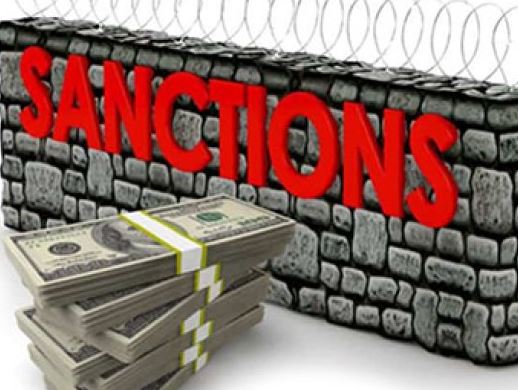
Toronto: Western governments have united to bring in a number of serious economic sanctions against Russia in retaliation for its violence in Ukraine, including the latest announcement that the US is revoking Russia’s “most favoured nation” status that will impose new trade tariffs.
The moves were not a surprise.

The US and its western allies have increasingly turned to sanctions, investment bans, embargoes and other forms of economic warfare over the last two decades.
But sanctions and economic warfare give rise to unintended consequences. They can divert from diplomatic mediation and dialogue.
They also carry a price for those applying the sanctions, as well as third parties who may be indirectly impacted by the sanctions.
The desire to use these financial tools is understandable, especially by the US government, because it means avoiding armed conflict.
After two decades of war in the Middle East and Afghanistan, economic warfare is more acceptable to war-weary western societies than boots on the ground.
Powerful nations often use economic warfare measures to avoid protracted or difficult diplomatic negotiations, or to weaken the target country for negotiations. Sometimes countries impose sanctions as a way to play for time or to strengthen their negotiating hand.
Imprecise tools
However, sanctions and economic embargoes are also imprecise tools — even the highly tuned interventions into bank accounts and financial flows which the US government developed after 9/11 to go after terrorist financing. They also have spin-off effects, which may not be predicted beforehand.
Research finds that the unintended consequences of economic sanctions and financial warfare measures are difficult to predict at the outset — and the more severe and encompassing the sanctions, the greater the unintended consequences.
Consumers in North America and Europe are seeing it now in surging gas prices. More inflation and supply problems are to come in western economies as the sanctions against Russia take effect.
The developing world is also feeling the war’s impact on grain supply and the unintended effects of the sanctions in surging food prices and other commodities.
Food shortages will once again destabilize societies in the developing world, as they did in the past with food riots in Egypt in 1977, 1984 and as recently as 2017.
Food prices will be impacted
Countries in Northern Africa and the Middle East are already on high alert as the war and wheat prices surge and cut into their staple grain supply from Ukraine and Russia.
South Africans are concerned about surging prices of energy and bread, which will hit the poor especially hard even as they try to recover from COVID-19, and about the more than 200 South Africans (mainly students) fleeing Ukraine for safety.
But there are other inherent dangers. Over-reliance on sanctions and economic warfare measures have led to strategic complacency and the avoidance of negotiations on the part of the governments of the western nations.
The announcements of sanctions against Russia are coming fast and furious. Politicians are anxious to announce their latest punishment of Russian President Vladimir Putin, Russian oligarchs and the people of Russia.
As a Canadian diplomat I witnessed the intended and unintended effects of US sanctions on the assets of North Korean entities in a Macau-based bank in 2005.
I’m currently researching the unsuccessful use of US financial sanctions on Hong Kong and China in response to the implementation of the National Security Law in Hong Kong.
I’m concerned the flurry of economic sanctions against Russia lack strategic clarity. Simply saying the sanctions are meant to punish Putin and Russian elites for their actions is not a serious strategy.
How will impacts be measured?
Other questions need to be answered: What mix of diplomatic tools are sanctions and economic warfare part of, and toward what end — what exact change in the target’s behaviour? When will we know that economic warfare has worked? How are governments tracking the effects, intended and unintended? When will the measures end, and how?
If the goal is a stalemate or to aid the Ukrainian effort to repel the forces back into Russia, how likely is that to be achieved given the asymmetry in the armed forces of the two sides?
Or is the goal even broader, such as destabilizing Russia to the point of regime change? That too could lead to unintended consequences, especially given the failed record of western governments in dealing with regime changes in smaller countries like Libya, Iraq and Afghanistan.
And what if the sanctions, investment and SWIFT bans, embargoes and arms transfers don’t work? Is there a point where the cost to human life is too high — in Ukraine or other places?
If the Russian military succeeds, would the economic punishments remain indefinitely? While some may make that argument, it would be the end of the globally integrated economy of the last 40 years, especially if China is somehow drawn into the conflict.
China would likely try to broker a cessation in the violence, but would not cease all financial transactions with Russia. That could lead to China developing alternatives to the SWIFT and U.S. Dollar payment systems.
The end of an integrated world economy?
One of the truths of the world order since the 1980s is that the world was increasingly open and integrated — especially the world economy, but also socially to a large extent.
Social movements on the political left and right have raged against the globalized world. But there were no major wars between the military superpowers in the eight decades after the Second World War.
The world order is now being undone by all sides.
It is time for leading world powers to think seriously about how to return to diplomacy, as unpalatable as this may be at this point.
Though it may sound tepid to call for mediation and dialogue, cooler heads are needed to work toward a ceasefire and to get serious and strategic about finding a negotiated solution in the Ukraine. Off ramps need to be found from the intensifying violence.
Sanctions, embargoes, financial bans and arms transfers with no negotiated end in sight is not the solution, tempting as they may be for western governments. Further escalation only leads to the unthinkable.
By Gregory T Chin, Associate Professor of Political Economy, Department of Politics, York University and former Canadian Diplomat, York University, Canada
The Conversation