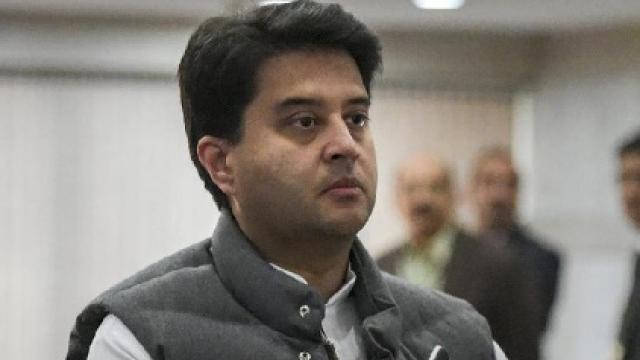
New Delhi: Communications Minister Jyotiraditya Scindia Friday asserted that satellite communications services can only start after clearance from the home ministry and questioned Congress leader Rahul Gandhi for siding with US business tycoon Elon Musk on his allegations against the government.
Speaking to the media at the India Mobile Congress 2026, Scindia said India does not allow monopolies in any sector, and that despite the buzz around one “particular” company, three players have received satcom licences and start operations only after individually meeting security requirements and milestones.


“I think the Government of India and the Ministry of Home have to state that you have successfully shown compliance with the security requirements. That’s when security requirements have been met. As I said, that is something that comes under the Ministry of Home, and that is a decision that will be taken by them,” the minister said.
He was replying to questions about allegations Musk levelled against the government, claiming his company Starlink’s operations have been kept on hold under the influence of an Indian conglomerate.
The Indian government and Elon Musk engaged in a verbal spat on Thursday after the Telecom Department rejected allegations that domestic business interests were blocking Starlink’s satellite internet services, leading the tech trillionaire to ask if “Ambani is the real boss of India”.
The government has slammed the US business tycoon over his allegations that Starlink’s satcom services are being blocked and made it clear that every satcom licensee in the country must demonstrate compliance with security norms.
Within hours of the government’s rebuttal, Musk asked in an X post whether “Ambani is the real boss of India”.
Congress leader Rahul Gandhi reacted to the post, indicating support for the allegations.
“Welcome to India, Elon. Wait till you discover the other guy,” Gandhi tweeted.
Hitting out at Congress, in the backdrop of Rahul Gandhi and Elon Musk’s exchange on X, he said
“So I have already defined the government’s stand and the government’s policy, and I have mentioned to you that there are three parties who have a license. There’s not a single party. And as far as the Congress Party is concerned, I don’t understand. I don’t think they themselves know whether they’re going left or right,” he said.
He said that Congress initially had a problem with “a certain person getting a license” and pointed out, “Now they have a problem, and they’ve allied with that person in terms of why he’s not getting a license”.
“So I don’t know whether they have clarity in terms of where they’re going, but that is the case with the Congress, which is to be expected,” Scindia said.
The minister said India doesn’t allow monopoly in any sector.
“Let me set the record straight. For us, the Department of Telecommunications, we are technology agnostic…Our job is to be able to provide the bouquet of services to every single customer. It is for the customer to choose in a free market which service he or she prefers, and within that service bouquet, which company’s service he or she prefers,” the minister said at a briefing at India Mobile Congress.
Scindia said three entities, Musk’s Starlink, Reliance Jio’s satellite venture Jio Satcom, and Bharti-backed Eutelsat OneWeb, have already secured licences, while Amazon Kuiper has expressed interest and will need to follow the established procedure.
Scindia said that while there is a lot of conversation about one particular company, three have got satcom licences.
“We are very clear on our stand. There are three parties that have got a licence; as and when the government decides the charge system on the revenue basis, that spectrum will be assigned to them, and as and when they individually fulfil security conditions, then they can start operations,” the minister said.
The Telecom Regulatory Authority of India (Trai) has given its recommendation on spectrum prices for satcom services.
Scindia said discussions are held even after Trai gives its recommendations.
The Digital Communications Commission in its last meeting held on September 3 is learnt to have approved TRAI’s suggestion with minor changes.
The Union Cabinet has to take the final decision on the satcom spectrum.
When asked about the status of the next round of spectrum auction, Scindia said a fairly reasonable amount of spectrum has already been distributed.
“When requirements do come up, and as we move away move on towards 5G Standalone and then coming up to 6G, depending on the spectrum bands that are required, we will certainly hold the auction. We also want to monitor when there is a desirable amount of demand, and then we will hold the auction,” the minister said.
The country’s last round of spectrum auctions was held in June 2024 and fetched bids worth only Rs 11,340 crore. Only 26.5 per cent of the total quantum put up for auction was sold.