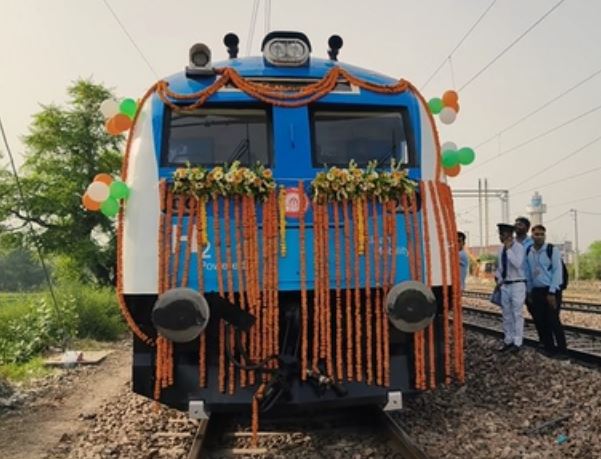
New Delhi: India got its first hydrogen-powered train Friday, when Prime Minister Narendra Modi flagged the passenger service from Haryana’s Jind railway station. The train will run between the Jind and Sonipat railway stations and cover the 89-km distance in two hours, with halts at 12 intermediate stations.
The following are the distinctive features of the train —


* A 1,200-kilowatt hydrogen-fuel-cell-propulsion system will power the 10-car trainset.
* The train will operate at a maximum speed of 75 km per hour.
* The train and the refuelling plant are equipped with devices to detect hydrogen leaks and unusual heat, along with an automatic shut-off system capable of cutting off hydrogen supply on its own, without waiting for a person to react.
* The pilot’s cabin is specifically designed to keep the person safe, with a special mode that allows the train to be moved to safety in an emergency.
* Powered by hydrogen-fuel-cell technology, which converts hydrogen into electricity to propel the train.
* Essentially an electric train that generates its own electricity on board. Instead of drawing power from overhead lines, hydrogen stored in high-pressure tanks reacts with oxygen from the air inside a fuel cell to produce electricity.
* Hydrogen fuel is produced separately, compressed, transported to the refuelling station and filled into the storage tanks on the train.
* Compared to diesel trains, a hydrogen-powered train eliminates tailpipe emissions, lowers dependence on fossil fuels and fossil-fuel imports, and operates with significantly less noise.
* Unlike conventional electric trains, a hydrogen-powered train does not require continuous overhead electrification infrastructure, as electricity is generated on board through hydrogen fuel cells, making them a clean and efficient solution.
* Hydrogen fuel cells typically have an efficiency of around 50-60 per cent in converting hydrogen into electricity. The efficiency of producing hydrogen through electrolysis is generally about 60-70 per cent, depending on the technology and conditions used.
* The use of green hydrogen — produced using renewable electricity — also reduces dependence on electricity generated from fossil fuel-based thermal power plants.
* The hydrogen-refuelling infrastructure consists of hydrogen production or supply facilities, compression systems, high-pressure storage tanks, dispensing equipment and safety systems. Hydrogen is compressed, typically to high pressures, stored on site and transferred into onboard tanks through specialised dispensing systems.