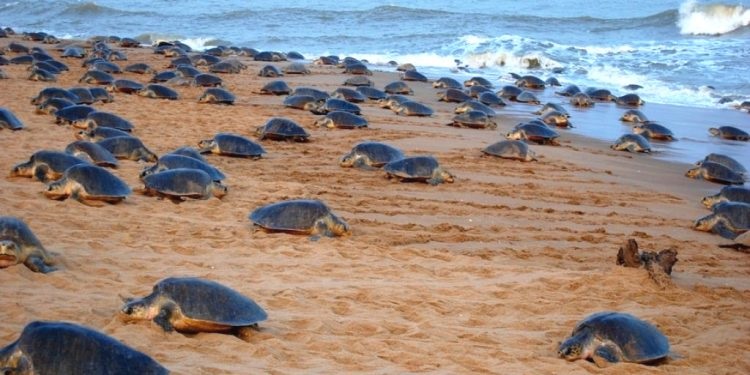
Bhubaneswar/Kendrapada: A study has found that Olive Ridley turtles, which congregate in lakhs for annual nesting on the Odisha coast, showed distinct movement and habitat use patterns between males and females.
This was part of the first-year findings of a three-year study by the Wildlife Institute of India (WII), Odisha Wildlife Organisation, Department of Forest, Environment & Climate Change, Dhamra Port Co Ltd (DPCL) and the Adani Foundation.


Odisha’s Forest, Environment and Climate Change minister Ganesh Ram Singhkhuntia Saturday released the first-year report of a three-year research initiative led by the Dehradun-based Wildlife Institute of India (WII).
The research brought together satellite telemetry, boat-based surveys and shoreline analysis to understand how Olive Ridley turtles used Odisha’s coastal waters and nesting habitats.
“The telemetry findings showed distinct movement patterns between male and female Olive Ridleys. Male turtles began their offshore migration earlier, while females remained in nearshore waters for longer periods. The data also pointed to possible foraging stopovers along the continental shelf and across the Bay of Bengal,” the report said.
The report also mentioned that one female turtle travelled 6,719 km over 271 days, reaching waters east of Sri Lanka. Another travelled nearly 200 km from Gahirmatha in Kendrapada district to Rushikulya in Ganjam district and back, highlighting the extent to which Olive Ridleys moved between different parts of Odisha’s coastline.
The boat-based surveys during the 2025-26 nesting season, the report said, recorded 1,390 individual turtles and 67 mating pairs. “Most sightings were recorded within two kilometres of the coastline. Sustained monitoring is required to better understand how these movement and habitat-use patterns could influence the conservation of nesting habitats,” the report said.
Odisha hosts some of the world’s most important Olive Ridley nesting sites, including Gahirmatha in Kendrapada district and Rushikulya in Ganjam district, where mass nesting takes place.
Protected under Schedule I of the Wildlife Protection Act, 1972, the species receives the highest level of legal protection in India.
The initial fieldwork focused on the Gahirmatha rookery, with satellite tagging at both Gahirmatha and Rushikulya. APSEZ operates Dhamra and Gopalpur ports in Odisha, the report said.
Dr R Suresh Kumar, Senior Scientist, WII, in a statement said, “This study marks the renewal of satellite tracking of Olive Ridley turtles in Odisha after nearly 15 years. The partnership with Odisha Forest Department, Dhamra Port and Adani Foundation has enabled us to generate new insights into the movement patterns and habitat use of these turtles. The findings provide a scientific foundation for evidence-based conservation planning. We will continue tracking more turtles to build a stronger dataset that can support management strategies and long-term conservation.”
PTI