
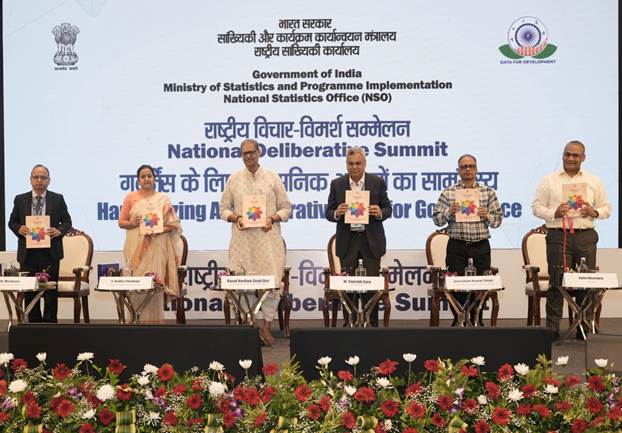
Bhubaneswar: The Ministry of Statistics and Programme Implementation (MoSPI) Wednesday launched the 27th edition of its flagship publication, Women and Men in India 2025: Selected Indicators and Data, during a National Dialogue on “Data for Development” held.
The publication presents a comprehensive snapshot of the status of women and men across the country, drawing on a wide range of official data sources.
It compiles gender-disaggregated indicators across key sectors such as population, education, health, economic participation, decision-making and gender-based violence.
To enhance usability, the report also provides detailed metadata for 50 key indicators, explaining concepts, definitions and methodologies.
Officials said the report aims to provide a strong evidence base for policymakers, researchers and stakeholders to better understand evolving gender dynamics and frame more inclusive, data-driven policies.
It includes rural-urban classifications, state and Union Territory-level data, and time-series indicators wherever available, offering a nuanced picture of development trends.
Among the key highlights, the report noted an improvement in the sex ratio at birth from 904 in 2017–19 to 917 in 2021–23, indicating better survival outcomes for girl children.
The country has also recorded a steady decline in infant mortality rates for both boys and girls between 2008 and 2023.
In education, gender parity has been achieved from primary to upper secondary levels.
The gross enrolment ratio in higher education also rose to 30.2 for females and 28.9 for males in 2022–23, reflecting wider access to advanced learning.
Economic participation trends show encouraging momentum, particularly among women.
The labour force participation rate has increased for individuals aged 15 years and above, with rural women recording the sharpest rise— from 37.5 per cent in 2022 to 45.9 per cent in 2025.
The report also highlights notable gains in leadership roles.
While the number of men in managerial positions rose by 73.8 per cent between 2017 and 2025, the growth among women was even more pronounced, registering an increase of over 100 per cent during the same period.
By mapping these trends, the publication underscores India’s gradual progress toward gender equality while identifying areas that require sustained policy attention.
The full report is available on the official MoSPI website.