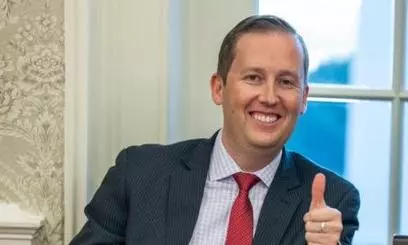
New Delhi: No partnership is better positioned than the one between India and the US to seize emerging opportunities, particularly in high-technology and critical minerals, US Ambassador Sergio Gor said Friday, while noting that only one per cent of issues remain to finalise the proposed trade deal between the two sides.
In an address at an event, the envoy also said that the US has been actively re-calibrating its export control policies to reflect the current technological and geopolitical landscape and balance legitimate security concerns with enabling commerce and innovation.


Gor touched upon various facets of India-US relations and said there is significant opportunities to expand it further in areas of artificial intelligence, trade and investment, critical technology, pharmaceuticals and research and innovation.
“We’re gathered at a defining moment, one where critical and emerging technologies are fundamentally reshaping the global balance of power. And I believe no partnership is better positioned to lead that charge than ours,” he said.
“At the same time of this immense transformation, I want us to be ambitious and shape the US-India relationship into the defining strategic partnership of the 21st century — one that delivers tangible benefits for both of our nations and our people,” he said.
Gor was speaking on ‘US-India TRUST Initiative: Advancing Partnership in Research and Innovation’ at the Indian Institute of Technology (IIT), Delhi.
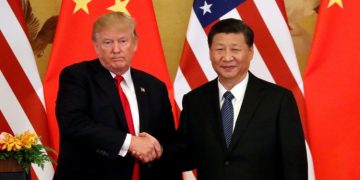
The Trump administration has identified “new centres of power” such as India, leading to initiatives such as TRUST or ‘Transforming the Relationship Utilising Strategic Technologies’ which was launched when Trump met Prime Minister Narendra Modi soon after beginning his second term, Gor said.
The goal is to encourage innovation with our most trusted partners while ensuring sensitive technologies are protected, the envoy said.
US Under Secretary of State for Public Diplomacy Sarah Rogers also briefly addressed the event, highlighting the importance the Trump administration attaches to its ties with India.
“I don’t think we could be luckier than we are to have a partner like India in a critical region,” she said.
In his remarks, Gor, citing the upswing in the bilateral economic engagement, said the proposed interim trade agreement between the two sides is nearing finalisation and that the bilateral trade has grown from USD 20 billion to over USD 220 billion in goods and services in just over two decades.
“Our current interim trade agreement is on the table for us to finalise and that will unlock prosperity for both of our countries. Just last week, India had sent a team to Washington DC to finalise the last one per cent of that trade deal,” Gor said.
“Next week, we will welcome a US delegation here to continue those talks. We fully expect that the trade deal will be signed over the next few weeks and months,” he added.
India and the US in February released a joint statement about agreeing on a framework for an interim trade deal for reciprocal and mutually beneficial trade.
Gor said deeper economic ties between the two sides reflected broader engagement and stronger economic integration.
“Our investment in trade expansion offers transformative potential. President Trump’s goal is to facilitate bilateral trade in a way that creates unprecedented opportunities for American businesses and workers.
“Our current interim trade agreement is on the table for us to finalise and that will unlock prosperity for both of our countries,” he said.
“Today, the US is one of India’s largest trading partners, and India is among the top trading partners of the US. Importantly, this growth is increasingly driven by innovation, investment and high value sectors, from digital trade and advanced manufacturing to energy and emerging technologies,” he said.
Gor said the US looks at its relationship with India with an “open hand”, noting that there are significant opportunities ahead to scale them into a “more seamless, resilient, and transformative economic relationship.”
“India’s growing economy and significant infrastructure needs align well with American expertise in energy, aviation, R&D, advanced manufacturing and digital infrastructure,” he said.
The US envoy also described Secretary of State Marco Rubio’s recent four-day trip to India as very substantive.
“I trust that you will all agree with me that there are no two nations better positioned than ours to combine strengths and place our people at the centre of technological transformation,” he said.
“Let us work together to make the US-India partnership the defining relationship of the 21st century,” he said.
The US envoy underlined the importance of critical minerals for key sectors including defence technologies and energy systems to power economies of both the nations while noting that there is huge opportunities for both sides to work in the sector.
India and the US this week firmed up a framework for cooperation in the critical minerals sector, a move that came amid growing concerns over China’s export controls on rare earth elements.
“The message that we want to send to everybody here and across the country is that the US is paying attention. The US is involved, and the US comes to India with an open hand,” Gor said.
The envoy also mentioned India-US cooperation in areas of pharmaceuticals.
“On pharmaceuticals, we import close to 40 per cent of our generics from India. There is a reason the United States does that: it is because we trust India. These are critical life-saving ingredients that are needed in the United States,” he said.
Gor said India is joining a network of trusted ecosystems and resilient supply chains that will define the future — from artificial intelligence to semiconductors and quantum computing.
“Our joint statement on the US-India AI partnership reaffirmed our shared vision for our innovation ecosystems,” he said.
“We agreed to adapt regulatory regimes that advance technological innovation and promote investment, deepen cooperation under the Pax Silica framework to support the supply chains of tomorrow and foster an environment where the AI revolution is driven by the creative power of the private sector,” he added.
PTI