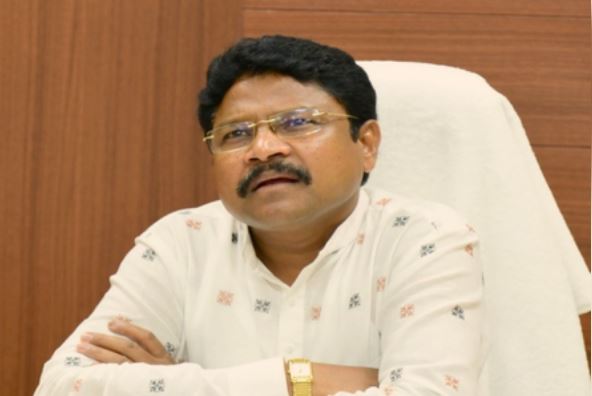
Bhubaneswar: Odisha has secured first position in distribution of Ayushman Bharat Pradhan Mantri Jana Arogya Yojana (ABPMJAY) cards to eligible persons in just nine months of its implementation in the state, Health minister Mukesh Mahaling said in Bhubaneswar Monday.
Mahaling was speaking at the National level Chintan Shivir on ABPMJAY and Ayushman Bharat Digital Mission (ABDM) here.


After inaugurating the two-day-long conference, the minister said the ABPMJAY was launched in Odisha April 11, 2025, in convergence with the state’s own scheme of Gopabandhu Jana Arogya Yojana (GJAY), in which each beneficiary family was entitled to cashless treatment of Rs 5 lakh per year, with an additional provision of Rs 5 lakhs for female members of the family.
Around 80 per cent of Odisha’s total 4.5 crore population was included under the converged scheme, Mahaling said.
Within nine months of its inauguration, Odisha stood in fifth position in the generation of Ayushman Vaya Vandana Yojana (AVVY) cards for the senior citizens of 70 years of age and above, he stated.
Over 22.41 lakh senior citizens above 70 years of age in the state are entitled to get benefits of the Ayushman Vaya Vandana Yojana, he said, adding that all senior citizens above 70 years of age, irrespective of their economic category, were also entitled to the same benefit under AVVY.
“ABPMJAY, the outcome of National Health Policy-2017 launched by our visionary Prime Minister Narendra Modi to bring a revolutionary transformation in the healthcare scenario of the country. It has now become the largest universal healthcare system in the world,” he said.
Around 42 per cent of India’s bottom-level population was brought under this healthcare system, he added.
Mahaling advised the participants to deliberate over the possibilities of including Ayurvedic and Homoeopathic packages in ABPMJAY along with the allopathic packages.
In his address, National Health Authority (NHA) chief executive officer Sunil Kumar Barnwal said that the digital platform of ABPMJAY and ABDM was so designed that many similar service delivery systems could be onboarded with it.
The large database that would be generated through ABDM would be very useful in disease mapping, disease surveillance, along with preventive and promotive healthcare, Barnwal said.
On this occasion, NHA signed three MoUs. One MoU was signed with BHASINI for multilingual access to health service, while the second agreement was signed with Indian Institute of Sciences for collaborative research, and the third one with National Accreditation Board of Hospitals (NABH) for upkeeping of national standards at the level of health facilities.
Among others, 119 delegates and senior officers from 27 states and 7 UTs have participated in the programme.
PTI