
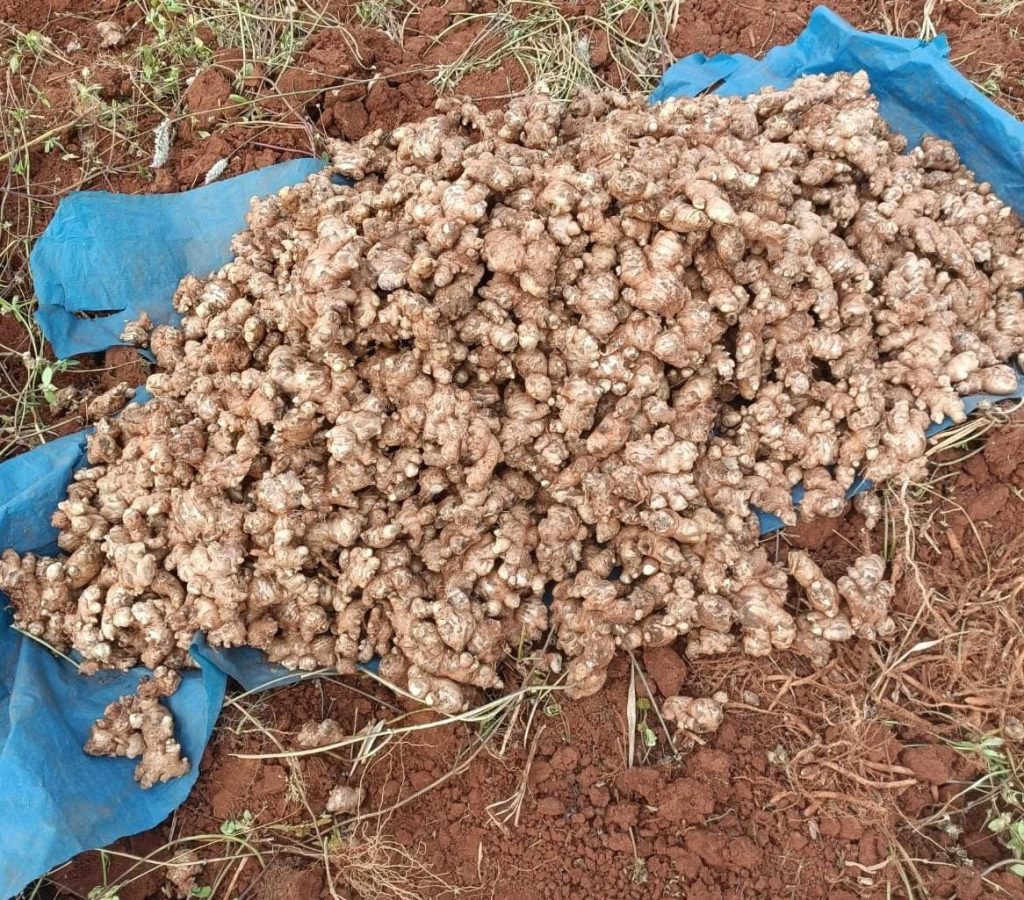
Nandapur: Ginger growers in Koraput district have alleged that weak marketing arrangements are denying them fair prices despite large-scale production of the spice, which has received recognition as a single-crop speciality of the district.
The district Horticulture department has set a production target of 58,121 tonnes duringthe 2025–26 Rabi season, as ginger was cultivated on 4,223 hectares in 14 blocks of the district.
However, farmers claim that after setting aside about 20 per cent of the produce for seed, there is no clear mechanism in place to decide where and at what price the remaining stock should be sold.
In the absence of official procurement or price support, farmers say they are being forced to sell ginger in local markets at Rs 20 to Rs 22 per kg. They allege the price is insufficient to recover cultivation and harvesting costs.
Also Read: Koraput dist admin bans non-veg food sale on Republic Day
Farmers and local intellectuals have urged the district administration, the horticulture department and the state government to intervene and ensure better marketing support.
According to the district deputy director of Horticulture Sudam Biswal, ginger cultivation during the 2025–26 Kharif season covered 875 hectares in Nandapur block, 368 hectares in Lamtaput, 887 hectares in Semiliguda, 1,185 hectares in Pottangi, 20 hectares in Narayanpatna, 110 hectares in Laxmipur, 215 hectares in Dasmantpur, 27 hectares in Bandhugaon, 150 hectares in Koraput, 78 hectares in Borigumma, 84 hectares in Kotpad, 82 hectares in Kundura, 69 hectares in Boipariguda and 71 hectares in Jeypore block.
He said the overall harvest has been good and reiterated that total production is expected to reach 58,121 tonnes.
Farmers, however, remain apprehensive that prevailing market rates of Rs 20 to Rs 22 per kg will not cover their production costs.
As many as 54 Farmer Producer Companies (FPCs) are operating across 10 blocks of the district to facilitate the purchase and sale of various agricultural produce.
Of them, 24 are engaged specifically for ginger trade.
Among these, Narishakti FPC is taking the lead role in ginger procurement and marketing in the district with support from NABARD.
The Odisha Rural Development and Marketing Society (ORMAS), functioning under the Panchayati Raj department, is also involved in agricultural marketing activities.
Several voluntary outfits, including Pragati and PRADAN, are extending support to farmers in marketing their produce.
This year, Narishakti FPC has set a target to procure 500 tonne ginger and has so far purchased about 180 tonnes. Pragati, which had set a target of 60 tonnes, has reportedly completed its procurement.
Similarly, ITC has set a target of procuring 200 metric tons of ginger and has already purchased around 100 metric tons.
However, several other FPCs are struggling due to a lack of working capital, resulting in sluggish procurement.
This has led to growing dissatisfaction among farmers, who remain uncertain about where and at what price they should sell their remaining ginger.
Taking advantage of the district’s weak marketing system, traders from neighbouring states are reportedly approaching farmers to lift ginger at throwaway rates.
Many distressed farmers say they are being forced to sell their ginger at low prices due to a lack of alternatives.
According to experts, a weak agricultural marketing system not only incurs losses to farmers but also leads to a decline in government revenue generated.
Although more than 25,000 women’s self-help groups operate under the Mission Shakti programme in the district, only four department-run ginger processing centres are currently functional, in Nandapur, Lamtaput, Semiliguda and Pottangi blocks.
Experts said ginger processing units should be established in every block to support farmers and add value to their produce.
They also stressed the need to ensure that functioning farmer-producer companies (FPCs) do not face a shortage of funds to procure and market ginger and other agricultural produce from the district.
They further called on researchers to focus on improving the quality of ginger produced in Koraput so that it meets international standards.