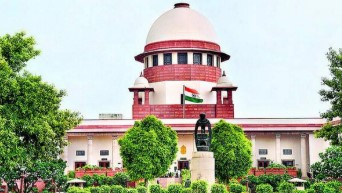
New Delhi: The Supreme Court has laid down a set of safeguards to prevent the misuse of the Protection of Children from Sexual Offences Act, 2012 (POCSO Act) in matrimonial and child custody disputes, cautioning that false allegations can cause irreparable harm to an accused parent while also adversely affecting custody proceedings.
A bench of Justices J.B. Pardiwala and K.V. Viswanathan, while dealing with a dispute between estranged parents involving allegations of sexual abuse against the father, said the safeguards would apply where a POCSO offence is alleged against a parent or family member living under the same roof as the child and a matrimonial dispute exists between the child’s parents.


It clarified that the police officer receiving the complaint must verify, at the stage of receipt of the complaint, whether such a matrimonial dispute exists between the parents.
The Supreme Court stressed that the safeguards would not dilute the object or stringency of the POCSO Act, which is intended to protect children from sexual assault, sexual harassment, and sexual exploitation.
“What is needed is a balancing exercise: precautions that neither dilute the object of the Act nor weaken its provisions, while allowing sufficient leeway to ensure that irreparable harm is not caused to the accused,” it said.
The top court directed that where the threshold conditions are satisfied, the investigating officer should not act in haste or immediately resort to coercive action in the form of arrest after registration of an FIR. It said the statutory requirements governing arrest under Section 35 of the Bharatiya Nagarik Suraksha Sanhita (BNSS), 2023, must be strictly complied with even in POCSO cases. It observed that, depending on the nature of the offence, the investigating officer must have the requisite “reason to believe” that the accused committed the offence and, in applicable cases, must also be satisfied that arrest is necessary for reasons such as preventing further offences, ensuring proper investigation, preventing tampering with evidence or securing the accused’s presence before court.
The Supreme Court further directed that, in cases falling within the prescribed threshold, the investigating officer or the Special Juvenile Police Unit (SJPU) will engage an expert in child and adolescent psychiatry or clinical psychology, in consultation with the District Child Protection Unit (DCPU) or, where the DCPU is unavailable, the District Legal Services Authority.
Such an expert would ordinarily be selected from the register maintained by the DCPU under Rule 5 of the POCSO Rules, 2020. Where no suitable expert is available on the register, an expert with equivalent qualifications may be engaged from outside it in consultation with the DCPU. However, the apex court permitted the investigating officer to dispense with the expert’s involvement in exceptional cases where the material is “palpable”, provided reasons for doing so are recorded in writing.
The psychological or psychiatric evaluation must be conducted independently and free from the influence of the disgruntled parent or the investigating authorities.
If a support person has been appointed by the Child Welfare Committee, that person may accompany the child during the evaluation.
The top court also made clear that the evaluation must comply with the POCSO Act and Rules and must ensure that the child is not subjected to pressure, discomfort or repeated harassment.
After the evaluation, the expert is required to submit a report to the investigating officer or SJPU. The report would be considered along with other relevant material and circumstances while deciding whether there is sufficient “reason to believe” for taking coercive action against the accused.
The Justice Pardiwala-headed bench clarified that the investigating officer would not be bound by the expert’s findings, as the report would only assist the exercise of discretion. It would also not constitute the sole basis for filing either a charge sheet or a closure report, with the investigation required to continue in accordance with law.
The Supreme Court also prescribed safeguards for private complaints filed directly before a special court under Section 33 of the POCSO Act. It said such a complaint should not be initiated lightly and the special court must first apply its mind to determine whether there are sufficient grounds to believe that an offence has taken place. The apex court clarified that a special court is not bound to take cognisance merely because a complaint has been filed. It must ascertain whether a prima facie case exists and ensure that the decision to take cognisance and issue summons reflects due application of mind to the overall facts and circumstances.
In such cases also, where the prescribed threshold conditions are met, the special court should involve an expert in child and adolescent psychiatry or clinical psychology, who would evaluate the child and submit a report to the court.
The Supreme Court said the special court should consider the expert report along with other relevant circumstances before forming an opinion on whether there are sufficient grounds to proceed with the complaint. In exceptional cases involving palpable material, the court may dispense with the expert’s involvement, but must record reasons in writing.
The apex court further addressed the impact of POCSO proceedings on parallel guardianship and custody litigation. It said where a child is the subject of custody proceedings between parents and a POCSO allegation is made against one parent or a family member living with that parent, the mere registration of a POCSO case should not by itself be treated as proof of the allegation or allowed to defeat the parent’s legitimate claim for custody or guardianship.
The court concerned must consider the relevant material, including material collected during the investigation, and form a prima facie view on a case-to-case basis as to whether the allegations are baseless, it said.
The bench also directed that courts dealing with remand and bail in cases covered by the safeguards should examine whether the investigating officer complied with the statutory requirements governing arrest and whether the circumstances arising from the strained relationship between the parents were duly considered. It directed all District Child Protection Units to update their registers under Rule 5 of the POCSO Rules, 2020, to include names of experts in child and adolescent psychiatry and clinical psychology so that the safeguard can be implemented effectively.
The Supreme Court stressed that the safeguards were necessary because false POCSO allegations in matrimonial disputes can result not only in loss of liberty but can also have a serious bearing on separate guardianship and custody proceedings. It observed that although Section 22 of the POCSO Act provides punishment for false complaints or false information in specified circumstances, substantial harm may already have occurred by the time that provision is invoked.
The court also stressed that the safeguards must not be understood as weakening the protection available to genuine victims of sexual abuse, observing that the objective was to prevent irreparable harm to an accused in appropriate cases without diluting the stringent provisions of the POCSO Act.
The judgment further directed that the safeguards relating to police-report cases would apply where investigation was still pending on the date of the judgment, while those concerning private complaints under Section 33 would apply where summons had not yet been issued.
The court ultimately quashed the POCSO proceedings in the case before it after considering an exhaustive CBI investigation, including witness statements, CCTV footage and psychological and psychiatric evaluation of the child, and held that continuation of the proceedings would amount to an abuse of the process of law.