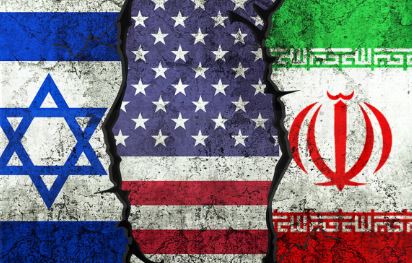
The ongoing conflict between Iran and the US-Israel combine is beginning to tell a story far removed from the early projections of swift American dominance. Instead, what is emerging is a far more interesting new narrative in which Iran is not only resisting but actively reshaping the contours of the war.
The latest in a series of embarrassments for the US is the downing of two American Stealth jet planes, both within 24 hours by Iran. What was projected by US President Donald Trump and his administration as a campaign of overwhelming dominance now appears far more contested. The loss of an F-15E fighter and an A-10 Warthog is not merely a battlefield incident, it is a strategic shock. For weeks, Washington had asserted near-total control over Iranian airspace and claimed to have “decimated” and “obliterated” their air defence systems. Yet, these incidents expose the limits of technological superiority when faced with resilient and adaptive air defence systems. The fact that Iran was able not only to strike these aircraft but also target rescue operations implies that the skies over that country are far from taken over.
Also Read


More than a month into the war, none of the objectives the US had claimed at the outset of the offensive have been achieved. Rather, the US today finds itself in a tight spot with no clear exit plans. Nothing illustrates America’s predicament more starkly than the abrupt ousting of the US Army Chief of Staff Randy George, and other senior military figures. Leadership changes of this magnitude in the midst of an active and overwhelming conflict cannot be seen as signs of strategic clarity. On the other hand, they point to internal discord, operational setbacks, or a growing disconnect between political objectives and military realities.
The decision by Secretary of War Pete Hegseth to remove top commanders raises troubling questions about coherence within the American war effort at a critical juncture. These developments come against the backdrop of an Iranian campaign that has proven far more resilient than anticipated. Despite sustained aerial bombardment, Tehran has demonstrated an ability to absorb pressure while continuing to retaliate profusely and effectively. The downing of US aircraft, persistent targeting of American assets, and the extension of the conflict across multiple fronts all point to a strategy that is adaptive and far from exhausted. There is, in this, a broader lesson about the limits of military power.
Technological superiority and initial momentum do not automatically translate into strategic success. Iran, by leveraging asymmetry, geography, and regional networks, has managed to complicate American and Israeli calculations and impose tangible costs on its adversaries. This conflict is no longer defined by overwhelming force alone, but by endurance and the ability to sustain pressure over time. Equally significant is the political dimension. Tehran’s refusal to engage on terms favourable to Washington underscores a confidence that it can withstand both military and economic coercion. That is the level of strategic independence that this new world order seems to demand.
For America, the month-long military campaign has turned out to be a sobering reality. A war that was expected to demonstrate strength is instead exposing fault lines, both on the battlefield and within its own command structure. Notwithstanding Trump’s threats of “obliterating” Iran’s assets and “raining down hell on them,” Tehran appears to have turned the tables on Washington. The biggest loser in this futile war could very well be Israel, which now should prepare itself for “all hell to rain down” on it at random and continuously. Countries supporting Israel, like Uganda, should prepare for a bleak future in a world that will not look on them with kindness or sympathy any more.
Orissa POST – Odisha’s No.1 English Daily