
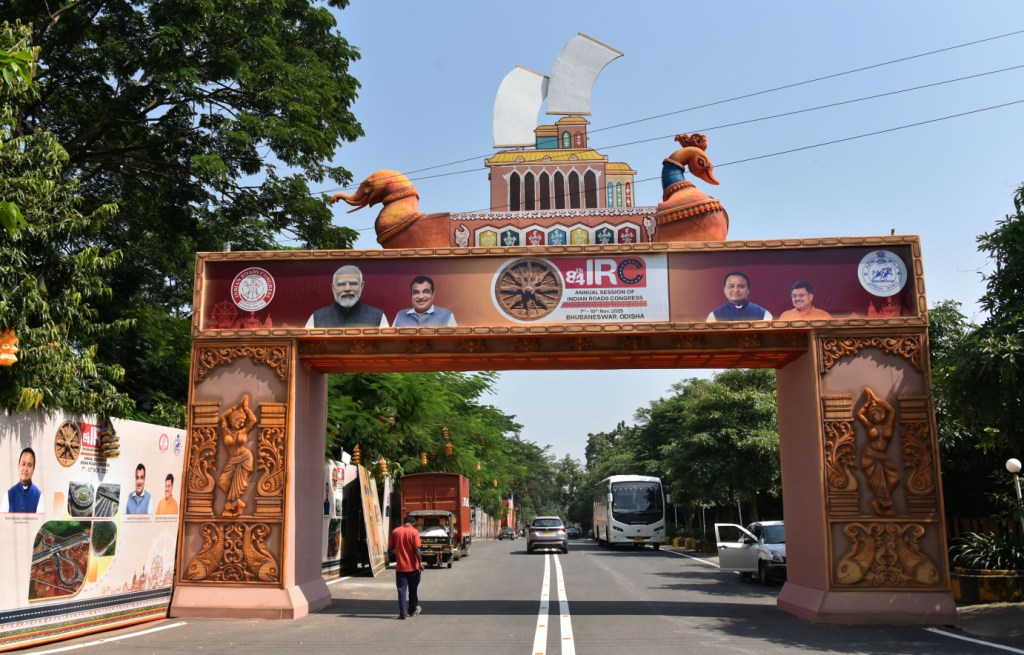
Bhubaneswar: When it comes to naming places, Odisha, in particular, its capital city Bhubaneswar has the most peculiar set of names that have been associated with some of the most interesting legends. Be it the famous Master Canteen square, which was purportedly named after a loving teacher who used to sell tea and snacks there or the Poonama Gate in the Old Town area which came to be called so after a girl named Poonam ended her life by jumping in front of a train at the same place, Bhubaneswar doesn’t have a dearth of folklores that give meaning to its existence making it a delight to live for its residents. Such a name is ‘IRC Village’ in the Nayapalli area of the Smart City; a relatively posh area, home to many rich and influential people of the State.
And as Odisha once again prepares to welcome delegates for 84th Indian Roads Congress, the story of IRC Village reminds us that sometimes, the most enduring legacies are born out of temporary beginnings. What is now a bustling, modern neighborhood in Nayapalli, once began as a temporary settlement built to host a grand national event — the ‘Indian Roads Congress’ (IRC). The story dates back to 1982, when Odisha was chosen to host the Indian Roads Congress for the second time — the first being in 1954. The event was a major milestone, as engineers, officials and dignitaries from across the country were expected to gather in Bhubaneswar to discuss India’s growing road network. However, there was one big challenge — Bhubaneswar in the early 1980s did not have enough hotels or guest houses to accommodate such a large number of high-profile guests. To solve this problem, the government came up with an innovative idea — to build a dedicated residential area just for the conference.
A piece of land in Nayapalli was selected for the project. Inspired by the Asiad Village built for the Asian Games, small and well-planned houses were constructed there to serve as temporary homes for the delegates attending the Indian Roads Congress. The new settlement soon became known as ‘IRC Village’, named after the event that gave it life — the Indian Roads Congress. For the duration of the conference, the area buzzed with activity, hosting engineers, ministers, and experts who had gathered to exchange ideas about the future of India’s roads. Once the conference ended, most delegates returned home — but the name stayed. The temporary settlement, built for a few weeks of use, slowly evolved into a permanent and prestigious residential area. Over the years, IRC Village transformed beyond recognition. The open fields that once hosted makeshift houses turned into a planned neighbourhood filled with modern homes, parks, and community spaces. What was once a short-term accommodation hub for guests of the Indian Roads Congress became one of Bhubaneswar’s most desirable addresses — home to officials, professionals, and families? The area’s name remains a living tribute to the event that first brought it into existence. The return of the Indian Roads Congress to Odisha in 2025 symbolises both continuity and progress — a reminder of how far the state has come in terms of development, planning and connectivity. Today, IRC Village stands not only as a residential hub but also as a symbol of Bhubaneswar’s growth and evolving identity. What began as a temporary solution has turned into a lasting landmark — a perfect example of how planning, purpose, and history can come together to shape the character of a city.
Orissa POST- Odisha’s No.1 Trusted English Daily