
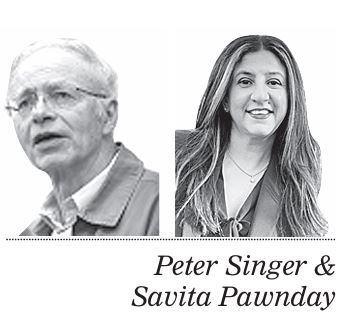
Peter Singer & Savita Pawnday
In 2005, the United Nations World Summit, attended by more than 170 heads of state and government, made a political commitment to prevent genocide, war crimes, ethnic cleansing, and crimes against humanity. But in endorsing the Responsibility to Protect, or R2P, did they also clear a legal path to the US-Israeli war against Iran? According to R2P, all states are responsible for protecting people from mass-atrocity crimes. The responsibility falls first on governments to protect their own citizens. If, however, they are powerless to do so, or are encouraging or carrying out the crimes themselves, R2P obliges other states, under specified conditions, to prevent such atrocities. The decision to endorse R2P stems from the 1994 Rwandan genocide, when extremist elements of the majority Hutu population attempted to eliminate the minority Tutsi population and Hutus who opposed the slaughter. In the aftermath, Kofi A. Annan, later UN secretary-general, asked whether, in the period leading up to the genocide, a coalition of states willing and able to prevent it should have stood idly by because the Security Council had not approved intervention.
A recent essay in The New York Times seeks to link R2P to the ongoing war against Iran. The author implies that we face a dire choice: either we answer Annan’s question affirmatively and say that, yes, his hypothetical coalition should have stood idly by while 800,000 Tutsis were massacred, or we say that it should have acted – and by implication accept what the US and Israel are doing to Iran. But that is not the choice we face.
To be sure, one could argue that the Iranian government’s slaughter of protesters in January – Amnesty International estimates put the death toll at between 5,000 and 20,000 or more, and even the late Ayatollah Ali Khamenei admitted to a death toll in the “thousands” – should have compelled a robust international response. But President Donald Trump’s administration has not sought to justify the US-Israeli strikes on Iran in terms of human-rights protection, atrocity prevention, or even international law. Instead, the administration’s purported justifications for its actions – however inconsistent and shifting – have centered on claims of self-defence. At various points, US officials have referenced threats, deterrence, and strategic objectives. Some of its rhetoric has veered toward regime change. The premise that R2P somehow provided the intellectual pathway for the US and Israel to attack Iran is based on a misunderstanding of R2P. At its core, R2P is not a doctrine about the general protection of citizens or human rights. R2P is explicitly anchored not in vague humanitarian concerns, but in the protection of populations from the four specific crimes mentioned above – the most conscience-shocking forms of violence punishable under international law. It creates no new exceptions to international law but rather builds upon existing legal obligations, including the Genocide Convention’s duty to prevent and punish. The argument that R2P creates a permissive environment for intervention might have resonated in the immediate aftermath of the intervention in Libya in 2011. But the trajectory since then has been very different. At a time when atrocity crimes continue to occur – from Gaza to Sudan to Myanmar – the central challenge facing the international community is not an excess of intervention justified under R2P. It is the persistent failure to mobilise collective action to protect populations from the gravest crimes under international law. R2P did not create a loophole in international law.
On the contrary, it was designed to ensure restraint, legitimacy, and accountability when the international community confronts mass-atrocity crimes. Today, the real challenge is that states have too often responded selectively to violations of international law – condemning some acts while remaining silent when their partners or allies are implicated in similar conduct. This inconsistency risks creating an atmosphere of permissiveness in which unlawful actions are tolerated rather than confronted. What is needed is more serious engagement, from the Security Council down, with the R2P framework – and with the difficult political realities that continue to prevent the international community from fulfilling the responsibilities it has already endorsed.
Peter Singer is Emeritus Professor of Bioethics at Princeton University. Savita Pawnday is Executive Director at City University of New York’s Graduate Center.