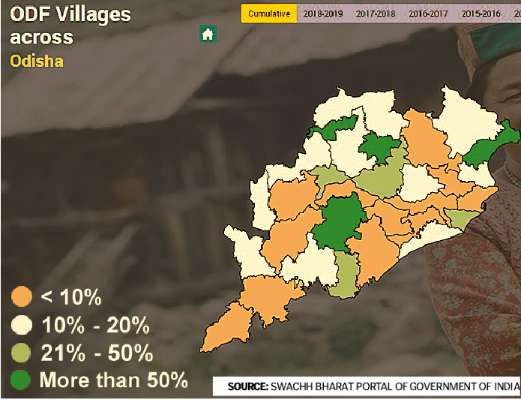
The Swachh Bharat Mission seems to be floundering in Odisha even after four years of its launch, with the state reportedly having the worst record of toilet coverage in rural areas compared to other states in the country. As per official records, Odisha which had a mere 11.75 per cent toilet coverage before the launch of the mission in 2014 has now 54 per cent Individual Household Latrine (IHHL) coverage. States like Bihar and Jharkhand which had worse records than Odisha a few years ago have surpassed the state with their improved sanitation coverage.
As per statistics furnished by the Ministry of Drinking Water and Sanitation – the nodal ministry handling the Swachh Bharat Mission – only two districts in Odisha have Open Defecation Free (ODF) status while most other districts are reeling under shortage of toilets.
The latest data claims that 19 out of the 30 districts in the state have sanitation coverage between 30 and 60 per cent. The ministry, on the other hand, is painstakingly planning to make Odisha ODF by the end of 2018.
The ministry claims that the worst performers in terms of implementation of the scheme at the ground level included districts like Kalahandi, Bolangir, Cuttack, Mayurbhanj and Jajpur which have shown the least progress in the flagship programme of the NDA government at the Centre. People involved in the project claim several reasons for the failure of the mission in many areas. As per the officials involved, executive engineers in districts take care of the toilet construction work. The programme guidelines bat not only for construction of toilets but also for works like intensive extension to make sure people are motivated to use the constructed toilets. Experts claim that in many districts there is lack of coordination between the officials due to the involvement of multiple agencies or lack of a vision plan at the district level.
“Executive engineers in districts are not much concerned about motivating people; rather they focus more on construction of toilets. We need more focus on social engineering and devise a plan to have a single line mechanism system without involvement of multiple levels for Swachh Bharat like we have in programmes like Livelihood Mission,” an official said on condition of anonymity.
It is worth noting that a free hand has been given to states to devise programmes for implementation of the mission as per their convenience as well as to monitor projects and scrutinise ODF claims, besides taking care of ODF plus activities in ODF declared areas.
SUCCESS STORY: Lulang leads by example


Before the launch of Swachh Bharat Mission most villagers in Lulang panchayat in Deogarh district had no option but to venture into the nearby fields to relieve themselves. Reason: Abysmal number of toilets in their village. Today that same village is a role model.
The panchayat in Reamal block of the district not only has 100 per cent coverage of individual toilets but it also ensures that not a single person goes out for open defecation. Strict self vigilance, fines on violators, observance of all norms as per SBM guidelines are some of the reasons that make the sanitation coverage of villages in the panchayat a marked success.
“There is not a single household which does not have a toilet of its own. Not only have we all have toilets but we also have decorated and painted the toilets. I can confidently claim that not a single person from the village ventures out for defecation. We have abided by all the norms of an ODF village,” said Santosh Kumar Rout, former panchayat sarpanch and a resident of Kirtanpalli village.
Kirtanpalli and other nearby villages of the panchayat like Chingudijharan and Similihata also show same results where 100 per cent coverage has resulted in 100 per cent usage due to several reasons, due mainly to the active participation of villagers and exemplary monitoring of the scheme at the ground level.
“We had passed a village resolution to fine defaulters `500 and reward the whistleblower `250 per case. We also planned to name and shame the defaulters. We have our monitoring committee (Swachhata committee) at the village level to carry out scrutiny,” said Jadumani Sahoo, member of the Swachhata committee which should be active in every village for monitoring of ODF status as per norms.
The results are visibly clear. “There has been a decline in the number of communicable diseases like diarrhea after the village became ODF as people shunned defecating in the open,” said Sanjulata Behera, ASHA worker from the village.
People involved in the project claim that the whole exercise was possible due to collaborated work. “In the panchayat, and even in the district, there were ample ‘swacchagrahis’ (ground level volunteers), monitoring committees and good coordination between all lines of officials from the district to the village level which made this a success,” said Kumuda Satpathy, SBM consultant in the district.
Follow-up failure hurdle in clean drive
Although the government claims that two districts of Odisha have been declared Open Defecation Free (ODF), there had hardly been any progress in most villages in Jharsuguda and Deogarh relating to post-ODF activities called ‘ODF Plus activities’.
The Swachh Bharat Mission guidelines as sent to the state governments for implementation said after the villages are made ODF, ODF Plus activities should be undertaken to make sure sanitation is ensured in every possible way.
The norms said: “Water, cleanliness of water sources and public water bodies, decentralised solid and liquid waste management, 3Rs (Reduce, Recycle and Reuse), maintenance of school and Anganwadi toilets, hand-washing and personal hygiene, hand-washing in school before midday meal, awareness and training on pit emptying and fecal sludge management should be taken up.”
However, visits to the villages proved most of these activities were abysmal even as awareness campaigns have been carried out at the village level in some pockets of the ODF districts. A number of villages still reel under water supply shortage and solid and waste management at the village level is still a utopian thought.
Visits to some of the ODF villages showed that there is no mechanism to treat waste and the villagers are left with no option but to burn the garbage they collect from the villages as neither a processing system nor a system to collect garbage from the village is in place thereby adding fuel to fire.
“We collect the garbage from our village regularly. Women Self Help Groups also come forward to clean the villages every week. But we have no option but to burn the garbage on the fields to clear the trash. There is no mechanism to treat or collect it at our level,” said Pradeep Majhi, a villager from Chingudijharan in Reamal block of Deogarh district.
Majhi claimed that his village had not been receiving piped water after one of the main pipes got damaged, which affects the villagers’ toilet usage to some extent.
Villagers of Similghatta, one of the cleanest villages in Deogarh’s Lulang panchayat, also said they collect garbage from dustbins regularly and burn it.
SBM aid yet to reach
Many villagers of Chingudijharan in Lulang panchayat rued that they had not received `12,000 Swachh Bharat Mission (SBM) assistance for constructing toilets despite the campaign to shun open defecation. They said their names were not there in the baseline survey of 2014 and it is likely that they would be deprived of government aid.
Villagers abhor ‘attached’ toilets
Several villages in Odisha, especially those in Deogarh and Jharsuguda, the two districts that have been declared 100 per cent Open Defecation Free (ODF), have one thing in common: Segregation of toilets from the main houses.
During visits to rural areas, villagers in most parts of the state were found to have a common habit of segregating the toilet from their main house complex. Many believe that building a toilet within a house is not “good.”
“Most residents of my village have made toilets at a particular distance from the house. We do not like to have toilets attached to our house. We find it not acceptable socially. Such things should be kept at a distance. How can we have both toilets and kitchens in the same house,” said Kailash Chandra Sahoo, a villager from Kirtanpalli in Deogarh.
Most villagers have ensured that the toilets are away from their houses by building them either on the rear side of their dwellings or at the corner of the courtyard, around 10 metres away from their houses. In villages where water supply is not an issue, people have tried setting up a water source next to the toilets which even the guidelines for toilet construction under Swachh Bharat Mission recommend.
“Either people build toilets on backyard of their dwellings or at the corner of a courtyard to segregate the activities associated with it. We want to keep our houses “pure”. In towns, due to lack of space, attached toilets have become a trend but in villages if we have space. We love to keep our houses and toilets segregated,” said Malati Behera, a villager said.
Toilet wall paintings boost sanitation drive in villages in Deogarh
Similihata in Lulang gram panchayat was like any other village in Deogarh district five years ago. Locals had the habit of defecating in the open in the absence of toilets in the village. Now it is a role model for others.
With the advent of Swachh Bharat Mission, a number of houses in the village got toilets of their own. However, the challenge was to make sure beneficiaries use the toilets they constructed under the scheme.
Then came the idea of ‘My Toilet Campaign’, envisioned by Kumuda Satpathy, consultant of SBM in the district, to increase ownership of toilets in the panchayat which effected changes on the ground. Padmini Pradhan, a 28-year-old Anganwadi worker from the village, was the first in her village who volunteered to start it with her toilet which later made Similihata a model for others. While the Gram Panchayat monitor (under the scheme) motivated the people to use the toilets, ground level motivators were roped in. Most of the toilets got a fresh coat of colour.
However, Pradhan took a step further to inculcate the habit of toilet use among kids. She was the first woman in the village to paint her toilet and make paintings on the walls of the toilet and emerged as the face of the campaign.
Soon, the innovative idea caught up with others. “I was the first in the village to paint the toilet walls. It not only added to the charm but also attracted kids and others to use the toilet as it became prettier. People started loving the idea,” Pradhan said.
Soon after Pradhan’s toilet got the paintings, several houses in her village replicated the model and painted colourful flowers, leaves and petals on their toilet walls. Not surprisingly, the colourful toilet walls caught the attention of other villagers in the gram panchayat who adopted the idea with gusto. Soon, ‘toilet wall paintings’ became a trend in the panchayat and pockets of the district.
Malati Behera, a native of Kirtanhalli village in the same panchayat, said: “It all started in Similihata village and we liked the idea. Later we started painting the walls of our toilets. Now all toilets in our village are painted. I think this has also helped us to view toilets from a different perspective and increase their usage and acceptability.”