
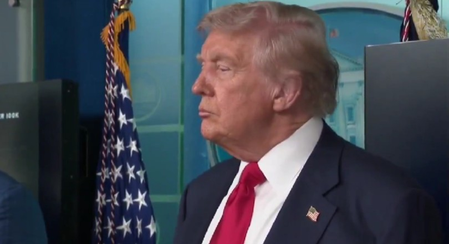
Dubai: US President Donald Trump threatened Thursday to launch major strikes on Iran and seize control of its oil and gas industries as continuing attacks between the warring countries pushed the Middle East closer to the resumption of a full-scale war.
Trump said in a social media post that the US would hit Iran “VERY HARD TONIGHT” and would “assume total control” of Iran’s oil and gas industries, including the key Kharg Island oil terminal, in the “not too distant future.”
Trump compared his plans for Iran to how the US assumed control of Venezuela’s oil sector after capturing then-president Nicolas Maduro in January.
The post come after the US and Iran traded strikes for a second straight day. The American attack, which lasted into Thursday morning in Iran, appeared more intense and widespread than the day before.
Iran released little information on the extent of the damage and said it fired back at Kuwait, Bahrain and Jordan, as it had a day before.
Trump’s threats on Thursday, while stark, represented his latest verbal escalation in the Iran war. In April, he warned Iran that “a whole civilization will die tonight, never to be brought back again” if it didn’t agree to his terms, before extending a ceasefire in the war.
Kharg Island – located on the other side of the Persian Gulf from US bases in Kuwait and Saudi Arabia – is the beating heart of Iran’s oil industry, through which 90 per cent of its exports pass. It is important because Iran’s coastline is mostly too shallow for tanker ships to dock.
American troops would be vulnerable on Kharg Island because of its close proximity – about 33 kilometres (21 miles) – to the Iranian mainland, from which missiles, drones and artillery could be fired.
US military fires on another merchant ship trying to run blockade
The US military continued to enforce its blockade of Iranian ports, saying Thursday it fired missiles to disable a tanker attempting to transport Iranian oil. An Indian official said a US strike on a different merchant ship earlier this week killed three Indian sailors.
It was the third time this week that back-and-forth strikes have rattled the Middle East. The first involved attacks between Iran and Israel, followed by the two rounds of fire between the US and Iran, which hit countries in the region that host American bases.
The new exchange of fire came as efforts to negotiate an end to the war appeared stuck, with US President Donald Trump warning that Tehran would “pay the price” for stalled negotiations. Iran’s Foreign Ministry said in a statement Thursday that the US attacks had “effectively rendered the ceasefire … meaningless,” without saying it was abandoning it.
Central to the negotiations is Iran’s stranglehold on the Strait of Hormuz, which has disrupted global energy supplies, driven up fuel prices and made food and other basics more expensive well beyond the region.
Iran announced Thursday that the strait was closed- but it was unclear what that meant since it has severely restricted traffic through the waterway since early in the war, and only a trickle of ships have gotten through. The US military’s Central Command disputed the claim, and Trump said Wednesday that the US has undertaken a secret mission in recent weeks to sneak ships through the passage.
The two sides also remain at odds over Iran’s nuclear programme, which Tehran insists is peaceful but which the US and Israel fear could be used to build an atomic weapon due to its stockpile of highly enriched uranium. The US and Israel said a major reason they went to war February 28 was to ensure that Iran would never be able to do that.
Iran has insisted that any deal to end the war must also end fighting in Lebanon between its ally Hezbollah and Israel. But Israeli Prime Minister Benjamin Netanyahu appears intent on pursuing his goal of destroying the militant group.
US strikes Iran and Iran fires back at Gulf states
Central Command said its latest round of airstrikes came “in response to Iran’s unwarranted and continued aggression” and targeted “Iranian military surveillance capabilities, communication systems and air defence sites.” It did not elaborate on the damage done by the strikes, which it said ended just before sunrise Thursday in Iran.
Explosions from the strikes echoed around Iran’s capital, as well as the port city of Bandar Abbas and other southern areas along the Strait of Hormuz. Iran’s paramilitary Revolutionary Guard later said sites hit included a manufacturing complex, a military barracks and a local Guard base outside of Tehran.
Kuwait closed its airspace for several hours because of the attack, but did not elaborate on any damage. Jordan said it intercepted 20 Iranian missiles fired toward an area that is home to a base hosting US troops, though no one was hurt.
Bahrain’s Interior Ministry said an 11-year-old girl was hurt and cars and homes were damaged by debris from interceptions responding to the Iranian attack.
Meanwhile, Israel warned residents in the country’s north to seek shelter after the detection of suspected incoming fire from Lebanon, where Israel is fighting the Iran-allied Hezbollah militant group.
Trump says the US is sneaking oil through the Strait of Hormuz
Iran’s ability to control the Strait of Hormuz has proved a strong bargaining chip since the narrow waterway’s effective closure has severely disrupted the global economy.
Trump said Wednesday that the US military has undertaken a mission since last month to sneak oil shipments past Iran’s forces in the strait, aided by the destruction of Iranian radar equipment.
Trump said as a result more than 100 million barrels of oil have evaded Iran’s chokehold. There was no immediate confirmation of that figure, which equals roughly five days of oil shipments through the waterway before the war began.
But the seas remain dangerous for mariners.
The US military’s Central Command said Thursday that it struck a Guinea-Bissau-flagged tanker attempting to evade the American blockade with a shipment of Iranian oil. It said Hellfire missiles were launched to disable the M/T Jalveer late Wednesday after the ship’s crew failed to obey US orders.
It’s the ninth merchant vessel the US military says it has disabled since imposing the blockade in mid-April in waters off Iran.
Orissa POST – Odisha’s No.1 English Daily