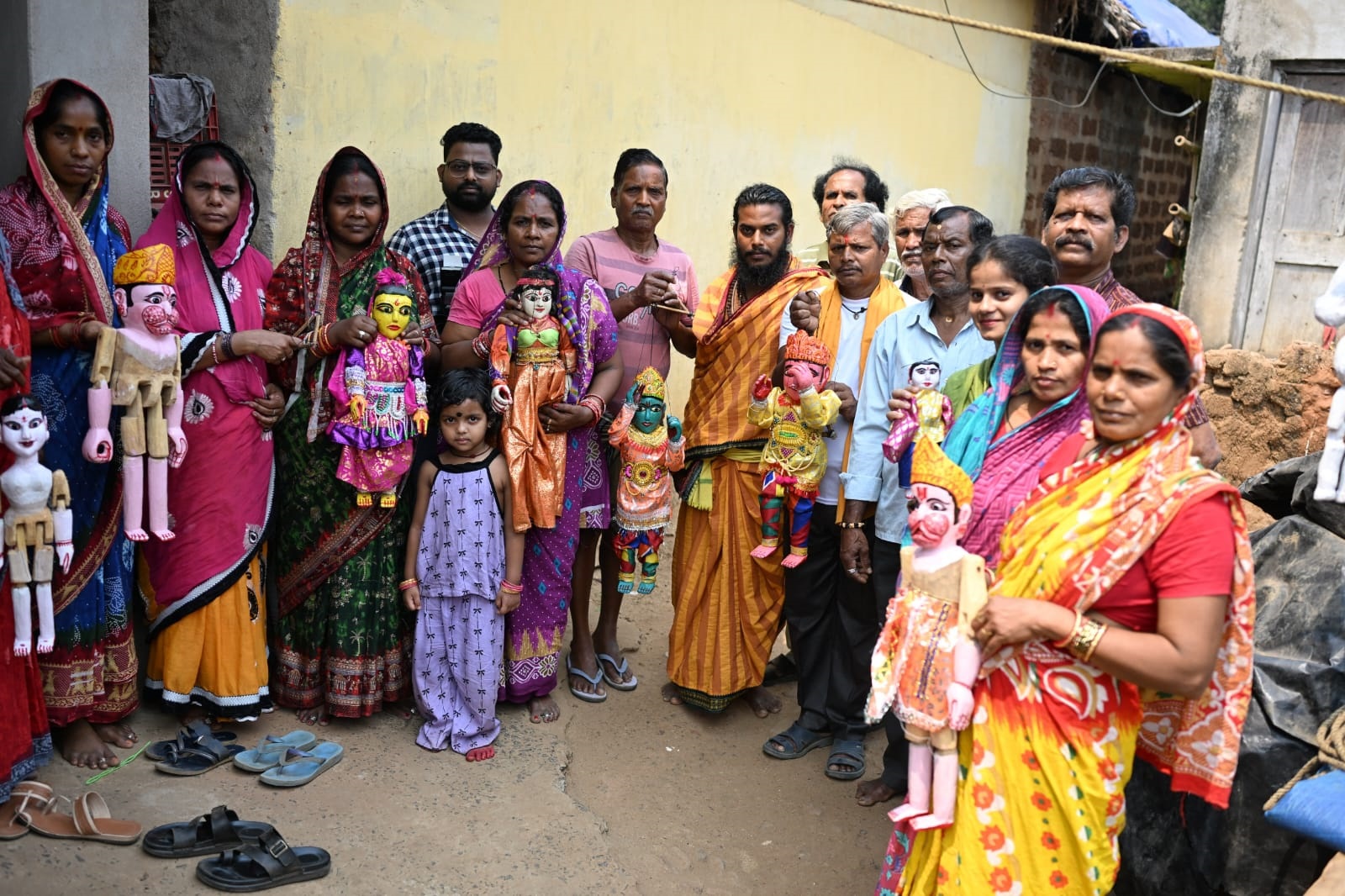
Dhenkanal: In the quaint village of Raidihi, the flickering shadows of Kandhei Nacha (puppet dance) tell a poignant story of cultural resilience amid growing neglect.
During the 35th Dhenkanal Heritage Walks (DHW) held Sunday, around 30 participants, led by DHW convener Suresh Prasad Mishra, visited the secluded hamlet—now regarded as one of the last strongholds of the folk art form teetering on the edge of oblivion.


Raidihi’s puppetry tradition dates back to 1952, when two villagers, Shatrughana Jena and Banshidhar Dhal, encountered puppeteers during a visit to Ganjam district.
Inspired, they brought the craft back and adapted it to local traditions, gradually turning Raidihi into a vibrant centre of puppetry.
Also Read: Jackfruit Mission goes haywire amid lack of market, processing
The art soon became part of the village’s social fabric. Traditionally, a father gifted a Kandhei Nacha puppet set to his daughter at marriage— not just as a keepsake, but as a means of livelihood for her new family.
India is home to four major forms of puppetry: Suta (string puppets), Gopa (rod puppets), Chhaya (shadow puppets), and Hastada (glove puppets).
Notably, Odisha is the only state where all four forms continue to survive. Among them, Suta Kandhei—the string puppet tradition—finds its strongest base in Raidihi.
Today, the village has 17 active puppet troupes, making it one of the most concentrated communities of traditional puppeteers in the region.
Many of these groups still travel across the state, bringing wooden characters to life through intricate finger movements, traditional songs, and dramatic storytelling.
Each troupe typically requires eight to ten performers to stage a full nataka (theatrical performance).
Despite its rich legacy, the art form faces an existential crisis driven by two major factors.
First is economic instability. With declining patronage and the overwhelming rise of digital entertainment, the livelihood of traditional puppeteers has become increasingly precarious.
The second challenge is a growing generational disconnect.
During a seminar held at the village hall as part of the heritage walk, local artists expressed concern that younger generations, seeking more stable and modern careers, are reluctant to continue the demanding craft.
Recognising Raidihi’s unique contribution to India’s cultural heritage, DHW organisers and local residents have urged authorities to officially designate the village as a “Heritage Puppet Village.”
Such recognition could bring institutional support, boost cultural tourism, and enable access to government grants to help sustain the tradition.
As the sun set on the Dhenkanal Heritage Walks, one message rang clear: Raidihi is not merely a village but a living museum.
If the strings of puppetry fall silent here, an irreplaceable chapter of Odisha’s cultural soul may fade into history.