
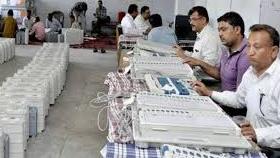
Kolkata: Signalling a potential political churn in West Bengal, long dominated by TMC’s Mamata Banerjee, the BJP crossed the halfway mark Monday, leading in 193 assembly seats against the TMC’s 94 as counting progressed, according to Election Commission data.
With the majority mark of 148 in the 294-member House breached in early trends, the BJP’s surge pointed to a possible breakthrough, while the ruling TMC sought to narrow the gap in what has emerged as a closely watched electoral contest.
The early numbers, indicating a possible outcome that could reshape the state’s political landscape following a fiercely fought election, also suggested a geographically split mandate, with the BJP pushing ahead in border, tribal and industrial regions, while the TMC held ground in parts of Kolkata and select rural strongholds.
Amid these trends, Banerjee urged TMC candidates and counting agents to remain vigilant and not leave counting centres, alleging a game plan by the BJP and the EC to project an early saffron lead.
In a video message, the TMC supremo appealed to party workers to stay put and not lose morale.
I appeal to everyone that neither TMC candidates nor counting agents should abandon counting centres, she said.
As trends on the Election Commission website showed the BJP leading in around 193 seats against the TMC’s 90-odd tally at that stage, Banerjee asserted that her party was ahead in a significant number of constituencies not fully reflected in the data.
We are still ahead in 170 seats and there are around 70 to 100 seats where we are leading, but they are not sharing the data, she said.
Her remarks came against the backdrop of an uneven pace of counting across constituencies.
In many of the nearly 190 seats where the BJP was leading, only 5-6 rounds had been completed, and in some, just two rounds, while a few had reached 10-11 rounds.
Given that most constituencies typically go through 18-22 rounds, the process appeared far from the halfway mark even by around 2 pm, suggesting that early leads could still see significant shifts as counting progresses.
Even as the broader trend favoured the BJP, Banerjee was ahead in her Bhabanipur stronghold by 9,475 votes over BJP challenger Suvendu Adhikari after 11 rounds of counting.
The Bhabanipur contest witnessed sharp swings through the morning, with Banerjee leading in the first round, trailing in the second, and regaining the advantage in the third, underlining the volatility of early trends.
However, in Nandigram, the other marquee battleground, Adhikari was ahead by over 3,135 votes against TMC’s Pabitra Kar after two rounds of counting.
Beyond the headline numbers, the trends indicated a deeper churn in the state’s political landscape.
For a party that has known uninterrupted power since 2011, the current numbers — with the BJP surging ahead in over 190 seats and the TMC trailing well behind — suggest the possible unravelling of a carefully constructed political machine that thrived on centralised authority, welfare outreach and relentless booth-level mobilisation.
The scale of the shift is reflected in emerging vote share patterns, with the BJP’s share rising to around 44.8 per cent, a sharp jump from 2021, while the TMC’s dipped to nearly 41.7 per cent, indicating erosion across segments that once formed its dependable base.
Perhaps more telling is the churn in the 177 constituencies where voter deletions had exceeded previous victory margins, a silent faultline that appears to have turned electoral.
The BJP was holding ground in all the seats it had won in this category in 2021 and making inroads into several of the 120 segments that the TMC had previously dominated, pointing to a deeper, more systemic shift rather than a transient swing.
Initial trends from across the state showed several TMC heavyweights trailing, triggering concern within the ruling camp.
In Cooch Behar district’s Dinhata, minister Udayan Guha was trailing by 6,259 votes against BJP’s Ajay Ray after four of the 24 rounds of counting.
TMC’s Manas Ranjan Bhunia was trailing in Paschim Medinipur district’s Sabang constituency, where he has won seven elections earlier, with BJP’s Amal Kumar Panda ahead by 693 votes after the third round.
In Kolkata, BJP’s Purnima Chakraborty was leading by 1,430 votes over TMC minister Shashi Panja, signalling early cracks in some urban pockets for the ruling party.
In Monteswar, BJP’s Saikat Panja was ahead by 13,308 votes over TMC’s Siddiqullah Chowdhury, while in Asansol Dakshin, BJP leader Agnimitra Paul was leading by 18,812 votes.
Assembly Speaker Biman Banerjee was trailing by 1,448 votes in Baruipur Paschim.
The BJP was also leading in a number of seats, including Dinhata, Gosaba, Baghmundi, Bankura, Durgapur Purba, Binpur, Nayagram, Rajganj and Bhagwangola, indicating traction across Junglemahal, north Bengal and industrial belts.
In contrast, the TMC retained leads in pockets such as Deganga, besides urban seats like Kasba, Ballygunge, Bhabanipur and Entally, and rural belts including Singur, Raina, Jamalpur, Khandaghosh, Sitai, Malatipur and Mothabari.
The CPI(M) was leading in Domkal in Murshidabad district, while the ISF was ahead in Minakhan in South 24 Parganas.
Aam Janata Unnayan Party chief Humayun Kabir was leading in Nowda and Rejinagar, whereas the Congress was leading in the Raninagar seat in Murshidabad district.