
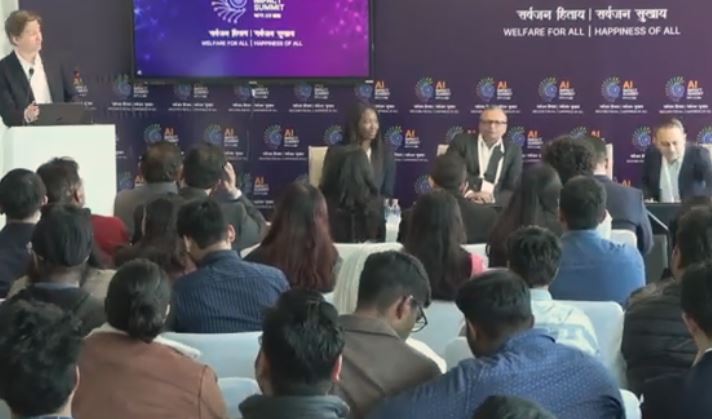
New Delhi: The world’s largest artificial intelligence summit opened to packed halls and long queues Monday, as tech moguls, industry leaders, policymakers, founders, and technologists thronged the venue for the conference, where India is set to push for widening access to AI and seek international agreement on global AI commons.
With huge billboards around the city welcoming delegates, speakers and guests at the AI Impact Summit, Bharat Mandapam saw long queues much before the conference opened at 09.30 hours, signalling the interest in the subject and the conference.
The enthusiasm was high despite the fact that the high profile speakers – from Sundar Pichai of Alphabet to Sam Altman of OpenAI and Dario Amodei of Anthropic – haven’t even arrived in the country. Their sessions start not before Wednesday.
Final two days of the Summit – February 19 and 20 – will see more than 20 heads of state and government, including France’s Emmanuel Macron and Brazil’s Luiz Inacio Lula da Silva, along with Indian Prime Minister Narendra Modi, talking about the future of AI alongside business leaders and investors.
A team of PTI reporters on the ground saw long queues outside the halls that are hosting different sessions. There were some logistics issues, but the conference was orderly and well organised.
Multiple parallel sessions are happening at the same time and all of them are packed to capacity.
From February 16 to 20, the summit will feature over 3,250 speakers and more than 500 sessions.
“Sessions are packed. There are long queues, and once the halls fill up, doors are closed, which creates some hassle for those still waiting outside,” an enthusiastic participant said. “You have to be there for a session well in advance. One cannot float around from session to session like in other conferences.”
Another person said an interesting line up of speakers is drawing huge crowds. “There is a lot of buzz around AI.”
Organisers said registrations exceeded expectations, reflecting accelerating interest in AI infrastructure, enterprise adoption and sovereign compute capabilities.
Panel discussions on the future of employability in the age of AI, skilling, safe and trusted AI at scale, AI governance and infrastructure, generative AI deployment, and public sector use cases drew standing-room-only audiences, with participants crowding corridors between sessions to network and exchange ideas.
An expo where the who’s who of the tech industry – from Google to Nvidia, Amazon, Meta, OpenAI and Microsoft besides homegrown giants – put on display innovations on AI is held alongside. Focused on AI’s transformative impact, it includes 300+ exhibitions, 13 country pavilions, and addresses themes of People, Planet, and Progress.
The summit offers India not just a chance to showcase its vast tech-savvy population and engineering talent but also to push for democratizing AI access to the global south. Besides wider access to AI, New Delhi may also seek international agreement on ‘global AI commons’ or a repository of use cases for AI in key sectors that can be shared.
The UK hosted the first AI Summit in 2023 that focused on AI safety and extreme risks. The next edition in France in 2025 saw trumpeting big investments in the tech sector.
For Prime Minister Modi, it offers an opportunity to showcase the impressive digital infrastructure and tech prowess that has attracted the likes of OpenAI and Anthropic to set up operations in the country, as well as an array of data centres commitments by giants such as Amazon, Google and Microsoft.
Ahead of the Summit, Modi, in an interview to PTI, pitched India as a global hub for digital infrastructure and artificial intelligence, saying the country is ready to host the world’s data and lead the next wave of the technology revolution.
The summit is expected to focus on expanding access to AI technologies, strengthening digital public infrastructure and building consensus around shared global frameworks for responsible AI development. India is positioning itself at the centre of discussions on democratising AI and shaping international cooperation on emerging technologies.