
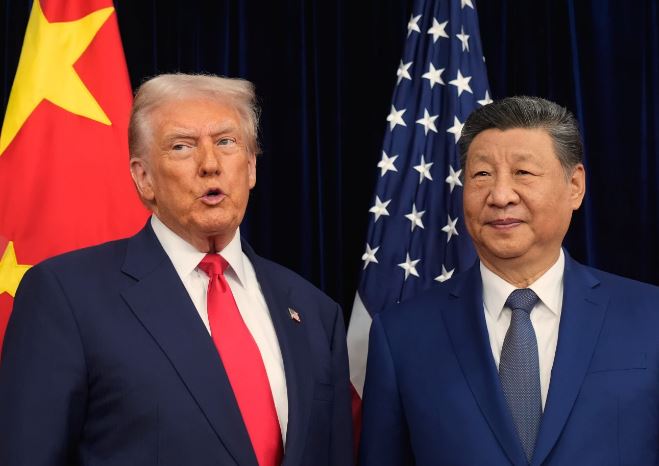
Finally, the much-awaited meeting between US President Donald Trump and his Chinese counterpart Xi Jinping is taking place. Trump’s three-day visit to Beijing from 13 May assumes crucial importance as the ongoing truce between Iran and the US-Israel combine and US-China trade relations will be put under a test. The visit will be the first to China by a US President in nearly a decade. The economic implications of the visit can be easily gauged from the list of executives from some of America’s biggest companies, including Boeing, Citigroup and Qualcomm, who are travelling with Trump. They are expected to clinch deals with Chinese firms.
In April 2025, Trump unveiled sweeping import taxes on countries across the world, both allies and adversaries. A major fallout of that policy was a tit-for-tat trade war between the US and China that saw them slap tariffs that topped 100 per cent on each other. The tariffs were put on hold after Trump and Xi’s last face-to-face meeting in South Korea in October 2025. However, despite the tariffs truce, a permanent resolution to the dispute continues to remain elusive.
Obviously, the Trump administration is too keen on pushing Beijing to make more purchases of goods from vital US industries, including soybeans and aircraft parts. But Trump’s bargaining chip has been weakened due to the setback to his trade policies after the US Supreme Court struck down his high tariffs regime as “illegal.” In desperation he turned to a separate law to impose a temporary 10 per cent levy on all countries in the meantime, while launching an investigation into China and other countries over unfair trade practices. Just this past week, for the second time, Trump suffered a jolt when a US trade court ruled that the latest global tariffs too were not justified. This means the Trump administration is going to be embroiled in legal battles within the country itself.
On the other hand, China’s massive investment in manufacturing means its businesses rely heavily on finding markets abroad as spending at home remains weak. China needs the US most as there is no single country as big as the US as a consumer market.
Without doubt, Beijing is going into this meeting rather from a position of strength. The reason for this is that China’s export figures have registered record levels which seems as an outcome of finding new trading partners around the world following weakening of ties with the US.
Iran is scheduled to figure prominently during discussions between Trump and Xi. With its vast oil reserves and diversified energy sources, China has so far seemingly deftly handled the situation arising out of the US’ war with Iran. It may be mentioned here that China is a major oil producer and most of its imported crude comes from Russia. India too was importing oil from Russia till the Indian Gov’t, of its own volition, refused to do so after buckling under pressure from the US. While these factors have enabled China to insulate itself from the impact of the conflict in the Middle East, India has fallen into terrible times. Beijing is also Iran’s biggest buyer of oil.
But China cannot afford to be smug as there are still signs that the war may drag on. This poses a threat to Chinese economy. Both China and the US wish the war in Iran to end as quickly as possible. The urgency appears more for the US than China, since Trump will have to face mid-term elections in his country in November with his popularity graph dipping low because of his one-sided war with Iran.
China has every reason to sit tight and watch how Trump wriggles himself out of the messy situation of his own doing. It is, however, incomprehensible how such a completely weakened Trump has managed to bulldoze and corner India into a situation of complete helplessness from which, it seems, it is not finding a way to crawl out.