By Avilash Roul
To begin with, managing freshwater, the elixir of life, has once again been put at the top of the unresolved scheme of the world. Several conferences, workshops and hybrid consultations are being organised to set the agenda for the Third UN Water Conference to be held in early December this year in the UAE. Meanwhile, the UN General Assembly sponsored the International Water Decade, designed to galvanise collaborative action on water-related challenges, which ends in 2028 and is largely off track. More strikingly, 2030 is fast approaching to meet the deadlines of ‘availability and sustainable management of water and sanitation for all’ under Sustainable Development Goals (SDGs).


Despite collective failure in managing water, the UN calls on all stakeholders on World Water Day (March 22) to amplify the role of water in reducing gender inequality. In fact, on World Water Day 1995, the UN emphatically urged world leaders to provide women with access to safe water, sanitation, and hygiene. After three decades of much pomp and circumstance, including several World Water Forums, the Millennium Development Goals (MDGs) and current SDGs, 26 per cent of women and girls – 1.1 billion – of the world lack access to safely managed drinking water. A joint WHO/UNICEF report (2026) estimates that 2.1 billion people still lack access to safe drinking water, 3.4 billion lack safely managed sanitation, and 1.7 billion lack basic hygiene services. Isn’t it disturbing that some 1 million lives continue to be lost each year due to inadequate access to safe drinking water, sanitation and hygiene (WASH)?
India is not far behind. In one of the so-called cleanest cities, Indore, 25 people died from contaminated drinking water in December 2025 and January 2026. Interestingly, between January 2025 and January 7, 2026, according to the Centre for Science and Environment (CSE), at least 5,500 people fell ill, and 38 people died in 26 cities, including 16 state capitals, across 22 states and Union territories after consuming sewage-contaminated piped drinking water.
It is still a common sight in peri-urban India for women and girls to fetch water from a distance. The gloomy arithmetic of water does not end in gender disparity alone. It is now crystal clear that climate change has severely disrupted and shifted the hydrological cycle, consequently putting lives, societies, and the security of the state at high risk.
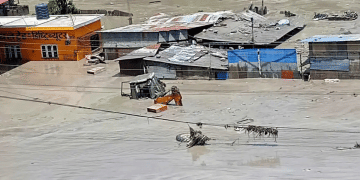
Water-related disasters in 2025, as per the Global Water Monitor Report, took nearly 5,000 lives, displaced around 8 million people, and resulted in economic losses of nearly $360 billion globally.
Since the ‘Water for Peace’ of the 2024 World Water Day, which was anchored in cooperation over transboundary rivers, hardly any member countries have entered into cooperation with basin countries. Rather, India has opted out of the 1960 Indus Water Treaty with Pakistan. On the Brahmaputra River, India has yet to enter into any long-term cooperative mechanism with the upper riparian China. A litmus test for India and Bangladesh is unfolding over the renewal of the Ganges Water Treaty that expires this year.
As a whopping three billion people are fed by an estimated 313 rivers and lakes and 468 aquifers shared by more than one country, which carry 60 per cent of the world’s freshwater, transboundary rivers have immense significance in managing an unequal water world. While Target 6.5 of Goal 6 of the SDG states that it will implement integrated water resources management at all levels, including through transboundary cooperation as appropriate by 2030, it is evident that the UN has been strained in its effort to facilitate the optimisation of transboundary cooperation.
Moreover, the UN or the collective approach to meeting the growing water needs must be reimagined and recalibrated. It can’t be the usual UN-type decadal developmental cycle of on-and-off focus on water management.
It is said that the world is entering an era of ‘global water bankruptcy’, in which replenishment and recovery are constrained. Who is responsible for this water bankruptcy? Aren’t the five decades of water bureaucracy, with aid and abetment of multilateral agencies and bilateral agencies, responsible for this water bankruptcy? What has been achieved under the ‘Water for All’ of ADB or ‘Water Secure World for All’ of the World Bank so far? If gender mainstreaming in water-sector investments worldwide is the hallmark of multilateral and bilateral donor agencies, there shouldn’t be gender disparity.
Water governance requires a transition from the present techno-bureaucratic crisis mode to a hydro-social, comprehensive, transparent, inclusive and flexible approach. Restructuring decision-making in water governance is key to resolving water challenges, particularly those related to gender. Galvanising global action on water must not be limited to slogans, campaigns, a day-long thematic focus or two days of conference.
The writer is international advisor on climate change risk and transboundary rivers. Views are personal