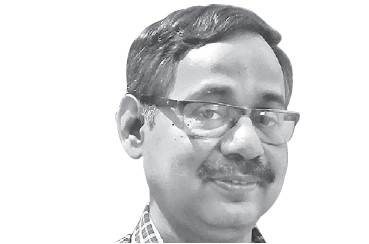
By Santosh Kumar Mohapatra
The latest income classification released by the World Bank in July 2026 deserves far greater attention than it has received. While public discourse in India continues to celebrate the country’s rapid GDP growth and its emergence as one of the world’s largest economies, the World Bank’s assessment presents a far more sobering reality.


Five countries—Sri Lanka, Vietnam, the Philippines, Jordan, and Micronesia—have been upgraded from the lower-middle-income to the upper-middle-income category. India, however, has remained a lower-middle-income economy since 2007.
This development should not be viewed as merely a statistical exercise. Rather, it should serve as an opportunity for honest reflection on the nature of India’s development model. Despite impressive macroeconomic achievements, why has India been unable to cross the upper-middle-income threshold while several neighbouring countries have succeeded? India has also slipped to the sixth position among the world’s largest economies in 2025, according to latest estimates released by the International Monetary Fund.
The contrast with Sri Lanka is particularly revealing. Only a few years ago, Sri Lanka experienced one of the worst economic crises in its history. The country suffered sovereign default, acute shortages of food, fuel, and medicines, political instability, and widespread public protests. Many observers viewed it as a classic example of economic failure.
Yet today, following painful but determined reforms, fiscal stabilisation, the revival of tourism, industrial recovery, and improvements in macroeconomic management, Sri Lanka has once again entered the upper-middle-income category.
Vietnam has achieved the same milestone through decades of export-oriented industrialisation, manufacturing expansion, investment in human capital, and rising productivity. The Philippines has also crossed the threshold after years of sustained economic progress.
India, meanwhile, is frequently described as the world’s fastest-growing major economy. However, this should not obscure an uncomfortable reality: the average Indian citizen has not experienced income growth sufficient to move the country into the next stage of development.
This raises several important policy questions. Has economic growth become increasingly concentrated among a relatively small section of society? Why has employment generation not kept pace with GDP growth? Why do millions of educated young people continue to struggle to find productive employment?
These questions become even more meaningful when examined through the intellectual framework developed by Nobel Laureate Amartya Sen.
Sen’s Capabilities Approach fundamentally transformed the way economists and policymakers understand development. According to Sen, development should not be measured merely by the amount of wealth a nation produces.
Instead, it should be judged by the real freedoms and opportunities available to people.
A central feature of Sen’s theory is the distinction between functionings and capabilities. Functionings refer to what individuals actually achieve—being healthy, educated, employed, well-nourished, or socially respected. Capabilities represent the genuine opportunities available to achieve these outcomes.
Two individuals may earn similar incomes, yet one may enjoy far greater capabilities because of better schools, healthcare, public transport, social support, gender equality, or freedom from discrimination. Income, therefore, becomes only one means of development rather than its ultimate objective.
From this perspective, poverty is much more than low income. Poverty represents the deprivation of capabilities—the denial of opportunities to live a healthy, productive, and dignified life. This understanding has profound implications for public policy.
Interestingly, Sen’s ideas also influenced the creation of the Human Development Index (HDI), which measures development not merely through income but also through life expectancy and educational attainment. This reflects a broader understanding that human well-being cannot be reduced to economic statistics alone.
India’s long-term ambition is to become a developed nation. That aspiration deserves wholehearted support. But becoming a developed country involves much more than achieving a large GDP or constructing impressive highways, airports, and industrial corridors. A nation’s progress cannot be judged solely by how much wealth it creates but also by how its people live, behave, and treat one another.
Sustainable development requires both economic prosperity and social maturity. India must therefore aspire not only to increase its GDP but also to strengthen the human values, civic culture, and institutional quality that together define a truly developed society.
True development requires that economic progress genuinely improves the lives of ordinary citizens.
The author is an Odisha-based economist and columnist.