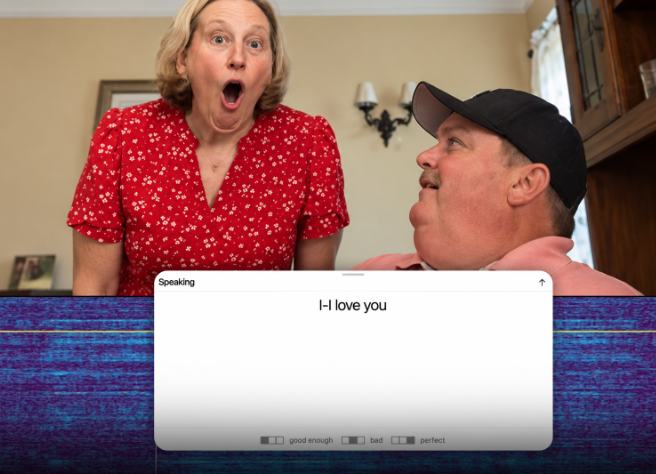
A simple “I love you” has become an extraordinary demonstration of how brain-computer interfaces could transform communication for people who have lost the ability to speak.
In a 23-second video shared by Elon Musk’s Neuralink, an unidentified clinical-trial participant appears to communicate the three words through a brain implant.


A synthetic voice delivers the message while his partner, standing beside him, reacts with visible excitement and surprise.
Musk later reshared the video, amplifying the emotional moment across social media. The demonstration follows a more detailed presentation released by Neuralink in March involving a participant identified as Kenneth.
Diagnosed with motor neurone disease (MND), known as ALS in the US, in 2024, Kenneth gradually lost his ability to speak.
Neuralink said he became the second participant implanted in its VOICE programme in January.
During that demonstration, Kenneth said he was communicating “with my mind” using the system.
Neuralink’s VOICE study is designed to investigate whether its wireless N1 brain implant can decode neural activity associated with intended speech and convert it into text or audible words.
Tiny electrode threads implanted in the brain record neural signals, which specialised software then attempts to interpret.
The technology, however, is not currently a machine for reading unrestricted thoughts.
Participants must deliberately perform trained mental actions—such as attempting to speak, imagining movements or intending to move a computer cursor—for the system to interpret the associated brain activity.
More broadly, a brain-computer interface (BCI) creates a direct communication pathway between the brain and an electronic device, potentially bypassing damaged parts of the nervous system.
Researchers are exploring BCIs for applications including restoring communication and movement, as well as helping people affected by paralysis, blind ness and other disabilities. Neuralink has said it had 21 participants enrolled in trials worldwide earlier this year.
Its first demonstrated human participant was shown playing video games, browsing the internet and controlling a computer cursor.
The field remains experimental, with implanted BCIs still used by relatively small numbers of people.
Yet moments such as an otherwise ordinary declaration of love illustrate why the technology has attracted intense attention: for someone unable to speak, three familiar words can represent an extraordinary return of human connection.