
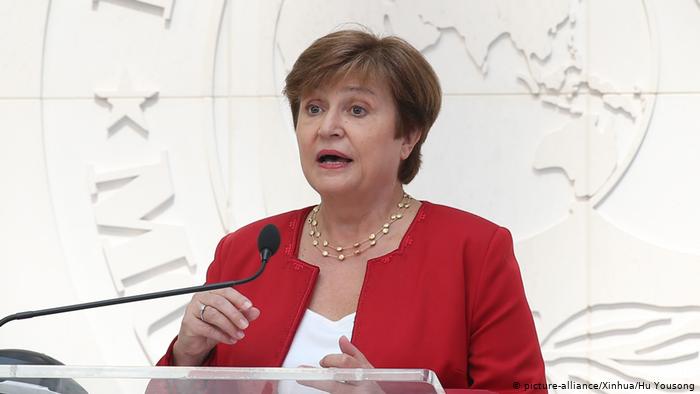
New Delhi: IMF Managing Director Kristalina Georgieva Friday said artificial intelligence could lift global growth by 0.8 per cent and help India achieve the Viksit Bharat goal, but poses a significant risk of displacement of jobs and financial stability.
While being optimistic about the technology, Georgieva cautioned against “sugarcoating” the impact of AI and called for striking a balance between building and managing AI as a ‘force for good, or a force for evil’.
“AI can lift up global growth by almost a percentage point. We say 0.8 per cent. It would mean that the world would grow faster than it did before the COVID pandemic. And that is fantastic for creating more opportunities, more jobs. This is the magnitude that we see for India, and it would mean that India’s Viksit Bharat is achievable,” Georgieva said at the AI Impact Summit, 2026.
She said AI creates potential for countries that go fast on digital infrastructure, skills, and adoption of AI, and countries must embrace the opportunities, while being mindful of the risks.
“I am very optimistic about AI. I’m also not naive; it brings significant risks,” she said while listing out three major risks from AI.
First, it brings the risk of making countries and the world less fair as some countries will have the technology and others don’t, and the other is the risk of financial stability, wherein AI could get loose and create havoc on financial markets.
Also, it brings the risk of displacement of jobs with no good thinking about how to help people find their place in the new AI economy.
“We calculated this risk as very high. We actually see the impact of AI on the labour market like a tsunami hitting it. Globally, 40 per cent of jobs will be affected by AI, some enhanced, others eliminated. In emerging markets 40 per cent, but in advance economies, 60 per cent. And that is happening over a relatively short period of time,” Georgieva said.
She said the IMF will continue to work with countries to understand what is happening in AI and then how to project it for policies for the future. “We have to be agile in how we look at AI,” she said.
A IMF research on how AI is affecting the labour market showed that in United States, 1 in 10 jobs already requires additional skills and for those who have the skills, the job pays better.
“Now, with money in their pocket, people then go and buy more local services. They go to restaurants, entertainment, then creates demand for low-skilled jobs. And to our surprise, the total impact on employment in the aggregate is positive. One job in with AI, 1.3 jobs on in total employment. What does that mean? It means that a smaller segment of people get higher opportunities,” she said, adding AI could eliminate some of the low-paying entry-level jobs.
“What concerns us the most is that jobs that disappear tend to be entry-level jobs. They are routine and they are easily automated. So if you are in this place of the labour market, that is easily automated, of course, that creates a risk for you,” she said.
She said to deal with AI advancement, there is a need to revamp education system for a new world. “People have to learn to learn, not to learn specific skills so much,” she said.
Also, there has to be support and social protection for the dramatic change in the labour market and to create an overall enabling environment for workers.
“It is important for the world to be very attentive to what works, what doesn’t work, and not sugarcoat the picture because if we do, we would end up where we ended up with globalisation. People revolting against it, despite all the benefits it brings, because, yes, the world was all benefitted, but some communities were devastated. And the world did not pay attention to this communities in a timely manner,” the IMF chief said.
The IMF is seeing how our countries are positioned in AI adoption with some countries actually have more demand for AI skills than supply, while some countries have more supply of AI skills than demand, and some have neither.
Stating that the most important factor in AI would be its ethical foundation, Georgieva said, “when I look at progress so far, we have done much more on the technical side of AI, and much less on building that strong, ethical foundation, and putting guardrails that are not restricting innovation, but are protecting us…”