
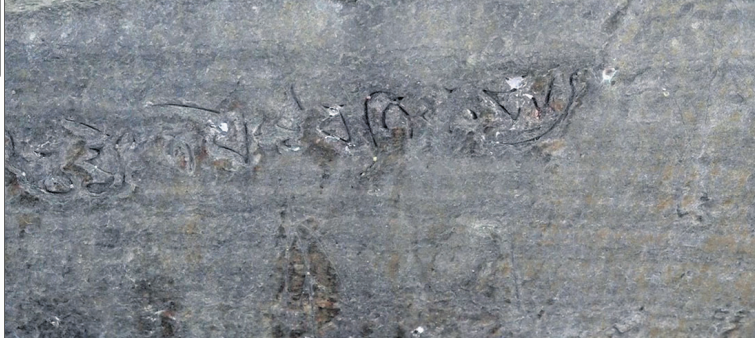
Baripada: A rare rock art site featuring ancient carvings and a Sanskrit inscription dating back to the seventh-eighth century AD has been discovered in the Paladha Salua forest near Chadakata village in Mayurbhanj district, a finding that researchers believe could shed new light on the history of northern Odisha.
The site, located under Kalapathar panchayat in Shamakhunta block at the foothills of the Similipal Biosphere Reserve, came into focus after scholars documented an inscribed stone locally known as Akshara Shila.
Situated on the bank of the Badamakhal stream, about 5 km from the Similipal foothills, the stone bears a series of engravings depicting human and animal figures alongside a rare Sanskrit inscription written in the Siddhamatrika script.
Researchers say the inscription, along with texts in early Odia, provides evidence of Sun worship and nature worship practices in the region during the early medieval period.
Dr Basanta Kumar Mahanta, assistant professor in the Department of Anthropology at Maharaja Sriram Chandra Bhanjadeo University, Baripada, said the discovery offers valuable insights into the cultural and religious traditions of the area during that era.
The site was first identified around seven to eight years ago by Dr Debabrata Nandi, professor in the university’s Department of GIS and Remote Sensing.
A team led by Dr D.B. Garnayak of the Archaeological Survey of India’s Puri Circle later visited the location and prepared a detailed report on the findings.
Experts believe further archaeological investigation of the site could reveal important evidence about the region’s early settlement patterns, religious practices and cultural heritage.