History will decide how the Supreme Court judgement on the Election Commission’s Special Intensive Revision (SIR) that has led to large-scale exclusion of voters in elections in West Bengal and other states will be viewed. The verdict pronounced by the bench of Chief Justice Surya Kant and Justice Joymalya Bagchi on 27 May is a sweeping and definitive victory for the Commission. It paves the way for a vigorous SIR exercise across more states that will likely lead to more exclusions from electoral rolls, forcing those impacted into a complex process of producing further documents and filing appeals if they ask to be readmitted.
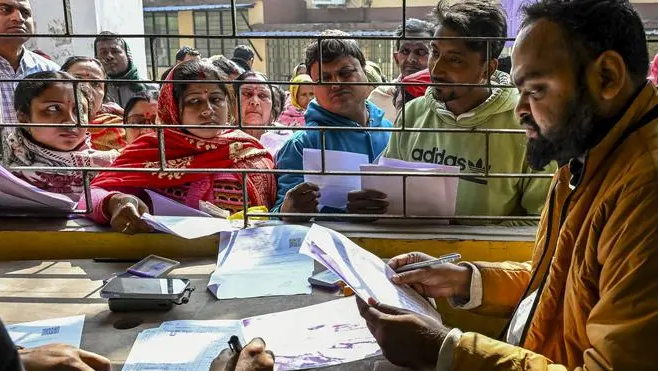
In that, the exercise poses a tremendous burden on those evicted from the electoral rolls under the SIR, even though they may have been on the rolls in the past and are citizens. One view of the tediousness of the process is seen from a publication by the Sa bar Institute, a Kolkata-based trust for disadvantaged communities. Its guide for those disenfranchised by the SIR, titled ‘SIR Appeal: A Citizen’s Handbook’, runs into 82 pages. This then becomes a case of a remedy available in theory but challenging in practice.
Also Read


The burden has been noted by the Supreme Court but not adressed. The Justices wrote: “… we are cognizant of the fact that an exercise of this magnitude carries the potential to cause hardship, particularly to those who may face difficulties in complying with procedural requirements. However, the doctrine of proportionality does not demand the elimination of all hardship; it requires that such hardship be mitigated through appropriate safeguards.”
The sweeping nature of the exercise and its ground-shaking impact on the elections system can be seen from the number of deletions on hand. In Bengal, long after the elections are over, about 25 lakh appeals against deletions from the rolls are pending with appellate tribunals appointed by the Supreme Court. Just last week, the head of the West Bengal Congress SIR Committee Prasenjit Bose noted that 6,581 appeals were disposed by the tribunals as of May 14 and 61% of those electors (4043 appeals) were restored – which means they were eligible to vote but could not vote in the April Assembly elections because their names had been wrongly removed from the rolls. If this trend holds, then it casts a doubt on the legitimacy of SIR and of the mandate in Bengal, given that voter deletions were greater than victory margins in several seats.
Apart from risks related to the integrity of the process, the SIR process also turns what is celebrated as the festival of democracy into a nightmare for the excluded. It can create divisions and split neighbourhoods, particularly when the numbers are large and hotly contested, as they have been in the most recent example in Bengal.
The messiness of the SIR process also points in a deeper way to a larger problem in the working of Indian democracy. This is the gap between the majestic grandeur of the constitutional framework as laid down and the imperfections that obtain when the framework is put to work in a nation marked by social, economic, political, and a host of other structural inequalities. Principles that are pristine and pure sitting at the Himalayan heights can break down into compromises, conveniences and sometimes cleverness when they are made to operate at the grassroots of a nation of 1.4 billion. The very requirements set by the process means that disadvantaged communities and poorer sections will find it more difficult to get documents, file appeals or fight back, and will likely be reconciled to sitting outside the electoral rolls, their right to vote effectively snatched away by the system.
Call it the difference between theory and practice, ideals and pragmatism or plans and reality, the act of enforcement can become detached from the spirit of what is envisaged in the framework of the Constitution, creating a gap between the professed and the practised. This gap needs to be watched carefully and narrowed continually because it carries the risk of defeating the purpose of the Constitution, of the laws and executive acts that flow from its guiding light and in the end of the Re public itself. In the SIR case, all evidence coming from the ground indicates that the gap has only widened.
Yet, there is no denying that on paper, procedures are impeccable. As the Court observed: “The impugned exercise was founded upon a legitimate and constitutionally grounded purpose, namely, the restoration of the accuracy, completeness, and integrity of the electoral rolls. Having regard to the nature of the problem sought to be addressed, the scale of the exercise undertaken, and the procedural safeguards incorporated during its implementation, the measures adopted by the Commission cannot be said to be disproportionate to the object sought to be achieved.”
Yet it is well understood that a blanket deference to experts carries the risk of disempowering ordinary people because advocacy, policy and decision-making in the hands of a few experts rarely includes the lived reality of the masses it will impact the most. In the case of the Election Commission, what it needs most to discharge its responsibility effectively is the complete trust of the people and the political parties, not the perfection of a voters list at the cost of excluding those whose voices may not be loud enough.
The writer is a journalist and faculty member at SPJIMR.