The denizens might remember that last year the palace was created by ‘Saheed Nagar Puja Committee’ and so whoever missed it then does have a chance to enjoy the grandeur of the palace once again
Bhubaneswar: Puja organisers in the city are trying their best to make their pandals unique and picturesque. So in an attempt to outdo others with fanciful sets and extravagancy, the ‘Nayapalli Durga Puja Committee’ is bringing back the magic of ‘Padmavaat’ this year.


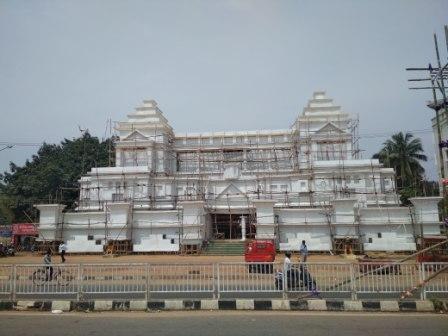
The organisers have roped in skillful workers and brainstormed their artistic imagination to prepare the pandal which is a replica of ‘Padmaavat’ palace in Chittorgarh, also known as Chittor fort in Rajasthan.
The denizens might remember that last year the palace was created by ‘Saheed Nagar Puja Committee’ and so whoever missed it then does have a chance to enjoy the grandeur of the palace once again.
Nabakishore Behera, adviser at ‘Nayapalli Durga Puja Committee’, said that the pandal is created by artists of Cuttack and Kolkata. “Around 60 artists have been working since the last three months and the pandal will be completed by October 1.”
It may be mentioned here that the Chittor Fort or Chittorgarh is one of the largest forts in India. It is a UNESCO World Heritage Site. The fort was the capital of Mewar and is located in the present-day town of Chittor. It sprawls over a hill 180 m in height and spreads over an area of 280 ha above the plains of the valley drained by the Berach river. The fort precinct has several historical palaces, gates, temples and two prominent commemorative towers.
Beginning in the 7th century, the fort was controlled by the Mewar Kingdom. From the 9th to 13th centuries, the fort was ruled by Paramara dynasty. In 1303, the Turkic ruler of Delhi, Alauddin Khilji defeated Rana Ratan Singh’s forces at the fort. In 1535, Bahadur Shah, the Sultan of Gujarat, defeated Bikramjeet Singh and took the fort. In 1567, Akbar defeated Maharana Udai Singh II’s troops. The fort’s defenders sallied forth to charge the attacking enemy but yet were not able to succeed. Following these defeats, the women are said to have committed ‘jauhar’ or mass self-immolation. The rulers, soldiers, noblewomen, and commoners considered death preferable to the mass rape and pillaging that was thought to occur following surrender to the Sultanate forces.
In 2013, at the 37th session of the World Heritage Committee held at Phnom Penh in Cambodia, Chittorgarh Fort, along with five other forts of Rajasthan, was declared a UNESCO World Heritage Site, as a group called the Hill Forts of Rajasthan.
Behera said, “We are expecting 2 lakh people every day till ‘dashami’.” The cost of making the pandal is Rs 20 lakh. The idol of Maa Durga is decorated with herbal colours, sunflower and Kaudi shells. Height of the pandal is estimated to be 85 ft with a width of 120 ft, he added.
Pabitra Mohan Behera, president of the committee, said, “From security point of view, we have installed 32 CCTV cameras inside and outside the pandal premises.” More than 200 volunteers and private security personnel will be deployed for the security.
Eyeing the religious occasion and the entertainment needs of the revellers, a ‘Ram Leela’ will be staged too. “We will also plant trees to compensate for the trail of destruction left by cyclone Fani.”
Last year, the ‘Altare della Patria’, a monument located in Rome, was replicated by the Nayapalli committee. The eclectic structure was designed by Giuseppe Sacconi in 1885 and completed in 1925. In 2017, the organisers went for the replica of the majestic Lakshmi Vilas Palace of Vadodara in Gujarat.