
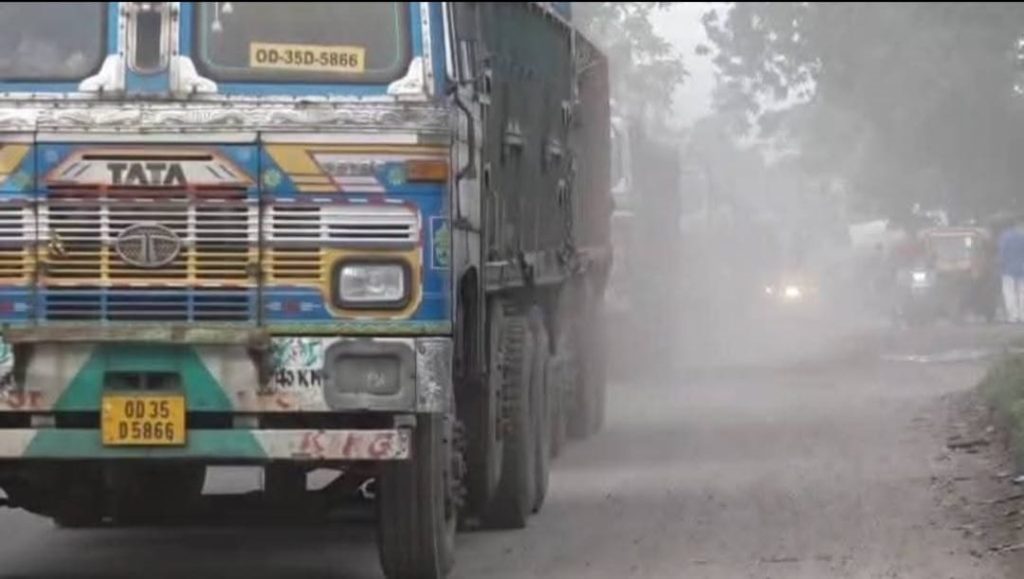
Talcher: The Angul district administration Saturday imposed a series of curbs in Talcher after air pollution in the city, a major industrial and coal hub, reached alarming levels making it the most polluted in the country.
The Air Quality Index (AQI) crossed 300, categorised as “very poor,” in six cities nationwide Saturday morning. Of these six cities, four are in Odisha. With an Air Quality Index (AQI) of 355, Talcher ranked as the most polluted city in the country, followed by Angul at second place with an AQI of 329.
While conditions were severe Friday, there was no significant improvement Saturday, raising concerns over prolonged exposure and its impact on public health. Officials warned that the high pollution levels pose serious risks to lung health, with even morning walkers reporting breathing discomfort.
In view of the “very poor” air quality in the Talcher Municipality area and keeping in mind the Graded Response Action Plan (GRAP) Stage-II guidelines, the Angul district administration has issued an order under Section 163(2) of the Bharatiya Nagarik Suraksha Sanhita (BNSS), as per Order No. 19.
Under the directive, multiple restrictions have been imposed across the Talcher Municipal Council area for the next seven days to curb pollution levels. Under the measures, all construction activities will be prohibited daily from 6 pm to 10 am. Any demolition or earthwork within the civic body limits has been banned.
Roads under the municipality area, the National Highways Authority of India (NHAI) and Mahanadi Coalfields Ltd. (MCL) must be sprinkled with water at least three times a day. Entry of heavy vehicles into Talcher has been completely barred. Open burning of garbage, burning of coal at roadside eateries, and lighting of any kind of open fire have been strictly prohibited.
Separate restrictions have been imposed on daytime movement of all coal and ash-laden trucks by the Talcher Sub-Collector and the regional transport officer. On National Highway 149, no truck will be allowed to operate without proper covering or tarpaulin. The NHAI and the NH Division, Pallahara, have been directed to ensure regular water sprinkling at all their construction sites.
The order will remain in force for seven days unless extended. Police, municipal authorities, all executive agencies and the Regional Transport Office have been directed to ensure strict enforcement. The district administration has instructed the Talcher Sub-Divisional Magistrate to conduct daily monitoring and submit a daily compliance report to the office.
Residents alleged that amid prevailing cold conditions, commuting on roads has become extremely difficult due to dense dust and smoke. According to locals, nearly 80 per cent of Talcher’s population is suffering from respiratory ailments. The soil and water in Talcher are already contaminated, and now even the air has become heavily polluted.
While the state and Central governments earn crores of rupees in revenue from Talcher, residents allege they are being deprived of basic rights. As people cry out in distress over the worsening pollution, public representatives, the administration, the pollution control board and industrial authorities are accused of remaining silent spectators, knowingly ignoring the crisis. Even access to clean air has now become a rarity in Talcher.