
Bhubaneswar: In a development likely to cheer wildlife lovers, Debrigarh Wildlife Sanctuary has emerged as a promising new breeding habitat for the endangered Indian dhole, also known as the Asiatic wild dog.
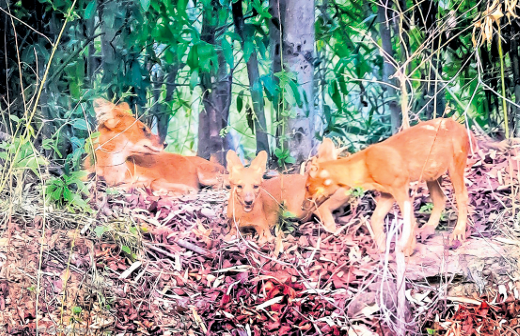
The sanctuary has recorded successful breeding of the elusive carnivore, with officials recently spotting a litter of two dhole pups through camera traps, a significant milestone for wildlife conservation in eastern India, Forest officials said.
“The birth of the pups is being viewed as a strong indicator of favourable habitat conditions, ecological securi ty, sufficient prey availability and effective protection measures within the sanctuary,” they added.
The first sighting of a lone Indian dhole inside the sanctuary was captured on camera traps in October 2023, an extremely rare observation in the region. Months later, another wild dog was seen accompanying it, and the pair subsequently began moving together across the sanctuary’s grasslands and hilly terrain.
By early 2026, offi cials no ticed that the pair’s movement had become restricted to a smaller core area, indicating that the female was in an advanced stage of gestation. During the third week of May, the mother dhole was recorded moving with two pups estimated to be three to four months old.
The pups were later captured on camera traps while moving along forest footpaths. Following the discovery, sanctuary authorities strategically installed 26 camera traps to closely monitor the animals while ensuring minimal human disturbance around the breeding zone.
Officials also recorded a deer kill near the resting site of the dholes, confirming active hunting behaviour and the availability of a healthy prey base. Wildlife experts described the development as particularly remarkable because the dhole pair appears to have bred without the support of a larger pack, uncommon behaviour that highlights the species’ adaptability and survival instincts.
To protect the vulnerable litter, Forest authorities have intensified surveillance and strengthened protection measures across the sanctuary. Movement near water bodies and salt licks is being carefully regulated, while frontline forest staff are conducting continuous monitoring to ensure the safety of the mother and pups.
Efforts are also underway to reduce threats from feral dogs, disease transmission and human interference in fringe areas of the sanctuary. Officials noted that the early stages of pup rearing are highly sensitive, as the young animals are still dependent on their mother for warmth, milk and protection.
The successful breeding is being hailed as a hopeful sign for the long-term survival of the endangered predator in Odisha. Conservationists believe the sightings could mark the beginning of a future dhole pack in Debrigarh and reaffirm the sanctuary’s ecological suitability for the species’ return.
Interestingly, officials remain uncertain about where the first dhole dispersed from and how the second animal eventually joined it. Dholes are known to travel long distances in search of territory, mates and prey, often silently reconnecting fragmented forest landscapes.
To strengthen wildlife protection, two additional anti-poaching check gates were established in 2022 and 2023, taking the total number in the sanctuary to 12. Authorities said the measures have helped secure nearly 300 sq km of relatively disturbance-free habitat within the sanctuary.
All border check gates are now under 24-hour CCTV surveillance with round-the-clock monitoring by protection staff. India is estimated to have around 1,000 to 2,500 wild dogs, primarily distributed across the Western Ghats, central Indian forests and parts of northeast India.