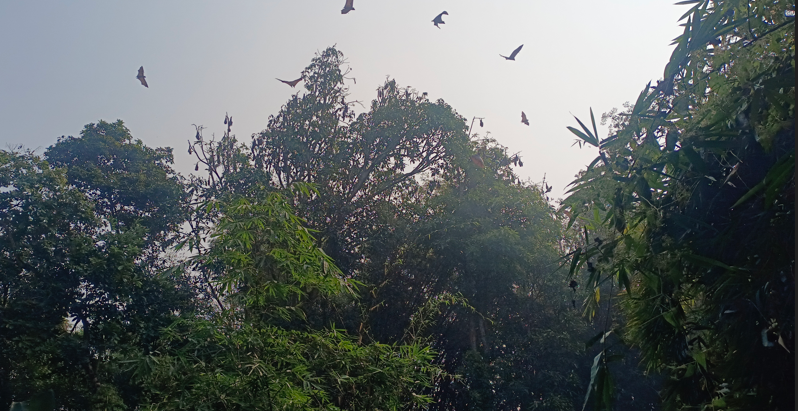
Khaira: A bat colony that has thrived for decades in Saradanga village under Khaira block of Balasore district is rapidly declining due to poaching, loss of habitat and alleged inaction by the Forest department, raising serious concerns among villagers and wildlife observers.
Once safely roosting on two tamarind trees, which are over 100 years old, the bats were left homeless after the trees collapsed in recent years.


Since then, the colony has scattered across bamboo, mango and other nearby trees, exposing the flying mammals to hunters, who locals say are capturing and selling them for profit.
Residents warned that unless immediate protective measures are taken, the colony could disappear entirely within a short time.
Also Read: Wildlife key to ecological balance: Tathagata
The bats first settled decades ago on two tamarind trees in the courtyard of an elderly woman known locally as Menki Mausi. Childless, she treated the bats as her own children and ensured their safety.
Later, she adopted Harekrushna Panda of nearby Kalamachua village as her son and arranged his marriage.
Panda, villagers said, continued her legacy by protecting the bats and preventing any harm to them. About 25 years ago, the then divisional forest officer of Balasore and the district collector visited Saradanga and expressed appreciation for the conservation of the bat colony.
Panda was rewarded with Rs 5,000, and assurances were given to provide water and other facilities to protect the bats during extreme summer heat. Locals said those promises were never fulfilled.
In recent years, with Panda’s death and Cyclone Phailin uprooting the old tamarind trees, the bats were left without a caretaker and shelter.
With no dedicated protection in place, the colony dispersed across nearby trees. Villagers alleged that poachers have taken advantage of the situation, using nets to trap and poach bats for monetary gain.
The threat intensifies as the breeding season approaches, further endangering the survival of the species in the area.
When contacted, Kupari forester Naresh Singh said the issue would be looked into.
Local residents have urged the Forest department to intervene urgently, restore habitat support and ensure protection for the bats before it is too late.