
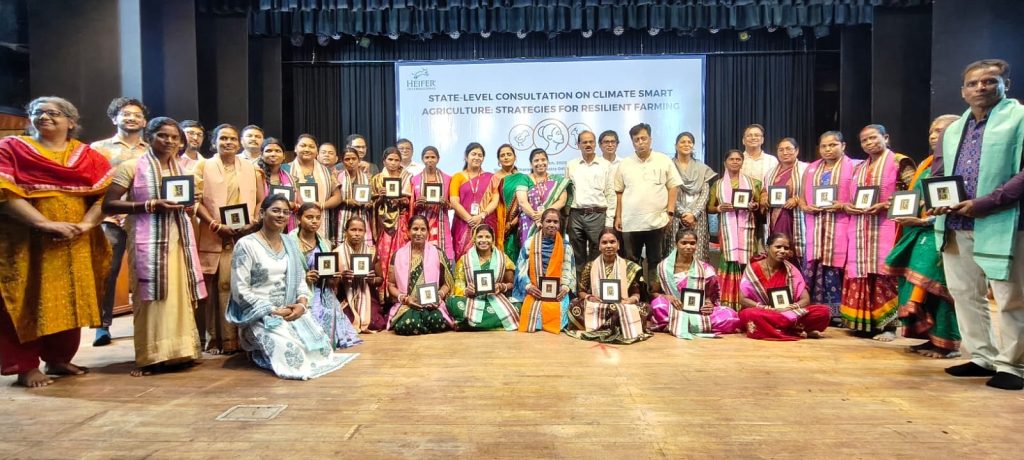
Bhubaneswar: A state-level consultation on “Climate Smart Agriculture: Strategies for Resilient Farming” was held Monday at the Guru Kelucharan Mohapatra Odissi Research Centre, Bhubaneswar.
The workshop was organised by Passing Gifts, a subsidiary of Heifer International, bringing together farmers, experts, development practitioners, NGO representatives, and academicians to discuss solutions for climate-resilient agriculture in Odisha.
The consultation saw participation from over 106 stakeholders, including progressive farmers, researchers, practitioners, and representatives from academic and development institutions.
Participants deliberated on practical strategies to help smallholder farmers adapt to climate change while improving agricultural productivity.
Also Read: Plastic push drives out siali leaf plates; tribals on receiving end
During the technical session, Sushanta Kumar Jata, Technical Officer at ICAR – Central Tuber Crops Research Institute (CTCRI), highlighted the importance of climate-resilient tuber crops such as cassava, yam, taro, elephant foot yam, and arrowroot.
These crops are drought and flood-resistant, require relatively low investment, and can provide good yields with fewer disease risks. They are also nutritionally rich and were once an important part of our staple diet,” he said, adding that improved harvesting and storage systems could further enhance their benefits for farmers.
Agriculture expert Ambika Nanda stressed the importance of diversified farming systems.
“Climate change is affecting every sector, and integrated farming is one of the most effective ways to build resilience and ensure sustainable livelihoods for farmers,” he noted.
Deputy Director of Extension at Odisha University of Agriculture and Technology (OUAT), Subash Sahoo, highlighted the urgent need to restore soil health.
“Excessive use of chemical fertilisers has gradually degraded soil fertility.
Promoting chemical-free and sustainable farming practices is essential to protect agricultural productivity for future generations,” he said.