
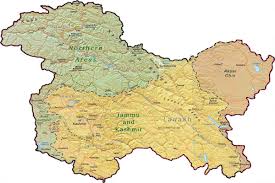
New Delhi: With a catalogue of review meetings, Home Minister Amit Shah has many crucial things on his agenda including redrawing the long pending delimitation of constituencies in Jammu and Kashmir. With President’s Rule operational in the strife-torn state, Shah has already had a closed door meeting with Governor Satyapal Malik. He also met Director Intelligence Bureau Rajiv Jain and Home Secretary Rajiv Gauba. Almost in parallel, it is believed that the Jammu and Kashmir Division in the vast swathe of Ministry of Home Affairs may be restructured.
The state has been under President’s Rule since December 18, 2018. This is likely to be extended beyond July 3. The security forces have been flushing out local militants and have already notched up 100 kills in the year to date.
Among the many plans on the drawing board is believed to be the boilerplate for fresh delimitation of constituencies and appointment of a Delimitation Commission. At the very kernel of delimitation is redrawing the scope and size of Assembly constituencies and determine the number of seats to be reserved for Scheduled Castes.
This is to correct an inequity and anomaly of regional disparity long suffered by Jammu province, and also provides representation to all reserved categories in the State Assembly. The main grouse of Jammu being that growing imbalance emerging out of composition of various constituencies would continue.
Another section of thought is that the Kashmir Valley claims that it has no Scheduled Castes or Scheduled Tribes while Gujjars, Bakerwals, Gaddis and Sippis were given Scheduled Tribe status in 1991 and form 11 per cent of the population but have no political reservation.
One needs to be mindful that the Constitution of Jammu and Kashmir, enacted in 1957, was based on the Maharaja’s Constitution of Jammu and Kashmir of 1939, which was still in force. After accession to India, the State Constituent Assembly was constituted under the 1939 Constitution, but Sheikh Abdullah’s administration arbitrarily carved out 30 seats for Jammu region and 43 seats for Kashmir region and two seats for Ladakh region. This regional disparity became entrenched thereafter: Kashmir (46), Jammu (37) and Ladakh (four).
During Ghulam Nabi Azad’s term as Chief Minister, he had recommended a proposal of 25 per cent all round increase in the number of Assembly seats of all three geographical regions in the state which would have resulted in an additional 22 constituencies in the Assembly. But PDP-Congress did not have the two-thirds majority in the Assembly and in any case the National Conference had opposed it.
According to the 2011 census, the total population of Jammu Division was 5,378,538 of which Dogras were the dominant group comprising 62.55 per cent of the population. Jammu has 25.93 per cent of the area and 42.89 per cent of the population.
Against this Kashmir Division or the inter-montane valley population in 2011 was 6,888,475 with 96.40 per cent Muslims. Though it has 15.73 per cent of the state’s area, it holds 54.93 per cent of the population.
Ladakh has 58.33 per cent of the area accounting for 2.18 per cent of the population, a mere 2,74,289 people reside there of which 46.40 per cent are Muslims, 12.11 per cent Hindus and 39.67 per cent Buddhist.
The last time a delimitation exercise took place in the state was also under President’s Rule, as far back as 1995 in extremely difficult circumstances by the Justice (retired) K.K. Gupta Commission.
Incidentally the Constitution provides for delimitation every 10 years, the next delimitation of Assembly constituencies should have logically taken place in 2005. However, in 2002, the Farooq Abdullah Government chose to freeze delimitation until 2026 by amending the Jammu and Kashmir Representation of the People Act 1957 and Section 47(3) of the Constitution of Jammu and Kashmir.
Convention says that the next delimitation can only take place after Census 2031, unless the Governor intervenes and rectifies this irregularity. In another peculiarity, the State Constitution, under Section 48, reserves 24 seats in the 111-member Assembly for the area under Pakistani occupation (since 1947-48).
IANS