
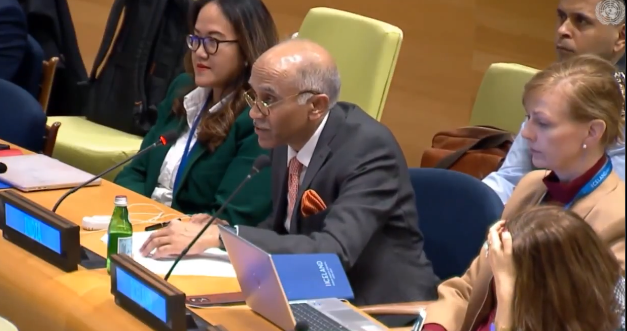
United Nations: India voiced its firm opposition to attacks on merchant shipping amid the ongoing Iran conflict, as it told the UN Security Council that several of its nationals have died or are missing due to attacks in the region.
“We expressed our deep concern at the conflict in Iran and the Gulf region that unfortunately began in the holy month of Ramadan and urged all sides to exercise restraint, avoid escalation and prioritise the safety of civilians,” India’s Permanent Representative to the UN Ambassador Harish Parvathaneni said Wednesday.
Addressing the UN Security Council open debate on ‘Maintenance of International Peace and Security: Advancing Political Solutions in the Middle East: Mediation and Dialogue for Lasting Peace’, Parvathaneni said India is firmly opposed to attacks on merchant shipping, as many of its nationals are prominent in its global workforce.
“Many Indian nationals have lost their lives or are missing as a result of attacks against countries of the region and against merchant vessels and sea lanes of communication,” he said.
Parvathaneni’s remarks in the Security Council came just hours after India summoned US charge d’affaires Jason Meeks in New Delhi and lodged a strong protest over a US attack on commercial tanker Settebello with 24 Indian crew members off the coast of Oman.
Also Read : Iran will never negotiate under threats or pressure: Ambassador Amir Saeid Iravani
Three of the 24 crew members on board the vessel went missing following the attack.
The attack on Settebello came two days after a Palau-flagged vessel with 24 Indians came under attack of the US Navy as the ship tried to evade the US blockade of Iranian ports.
Parvathaneni noted that there are almost 10 million Indian citizens who live and work in the Gulf region and underscored that their safety and well-being are of utmost priority to India.
“Our trade and energy supply chains are dependent on stability in the region and any major disruption has serious consequences for the Indian economy,” he said, adding that the intensification of the Iran conflict and its spread to other nations have evoked great anxiety.
“The mounting destruction and deaths and cessation of normal life and economic activities have deeply impacted India, a proximate neighbour with critical stakes in the security and stability of the region,” he said.
India strongly reiterated its call for dialogue and diplomacy, avoiding impeding freedom of navigation and commerce, avoiding military targeting of commercial shipping, avoiding targeting of the civilian population and infrastructure, and seeking an early end to the conflict. New Delhi also expressed its support for all efforts aimed at the peaceful resolution of issues.
India voiced deep concern over the ongoing conflicts in the Middle East, noting the immense humanitarian and human toll in terms of loss of lives, injuries and large-scale displacement of vulnerable civilian populations, impediments to freedom of navigation and consequent impact on global flow of commerce, including massive disruptions to established supply chains and global energy supplies.
India said the situation in Gaza has grave humanitarian implications that call for a sustained ceasefire, humanitarian access and a credible pathway towards a durable and peaceful resolution based on a negotiated two-state solution with a sovereign, independent, viable State of Palestine, living side by side in peace and security with Israel, within secure and recognised borders.
“This remains the only path to achieve lasting peace and overall prosperity,” Parvathaneni said.
He told the Council that India will be handing over 2.5 million dollars to the United Nations Relief and Works Agency for Palestine Refugees in the Near East (UNRWA) in the next few days, which will be the first tranche of Delhi’s annual five-million-dollar contribution to the agency.
Amid the crisis in Lebanon, India called for respect for Lebanon’s territorial integrity and sovereignty, emphasising that Indian troops are deployed in the United Nations Interim Force in Lebanon (UNIFIL).
“We call for ensuring the safety and security of peacekeepers. They carry out a vital mandate entrusted by this Council, and they must not be targeted. India will also be sending medical assistance to Lebanon,” he said.
India has condemned attacks against UN peacekeepers deployed in Lebanon and called for an immediate and thorough investigation to bring the perpetrators to justice. India further emphasised that mediation frameworks, once created, are not fit for purpose forever.
“If they fail to fulfil their mandated tasks and new realities emerge that make such earlier frameworks redundant, we must adapt and continue our efforts in tune with the new realities,” Parvathaneni said.
Citing the example of the Palestine issue, he said it is replete with outdated mediation frameworks that are not relevant in today’s context.
“Today’s Gaza Peace Plan and the Board of Peace framework are very distinct as compared to earlier frameworks,” he said.
India told the Council that raging conflicts in different parts of the world and the immeasurable human suffering are driving factors for the UN facing questions related to legitimacy, credibility and efficacy.
“The perception about this organisation has changed considerably among the world citizenry due to its inability to address conflict situations. A primary reason has been an eight-decade-old, outdated architecture of the Security Council, the principal UN organ that is tasked with maintenance of international peace and security,” he said, as Delhi called for implementing real reforms, through expansion of both permanent and non-permanent categories in line with current geopolitical realities.