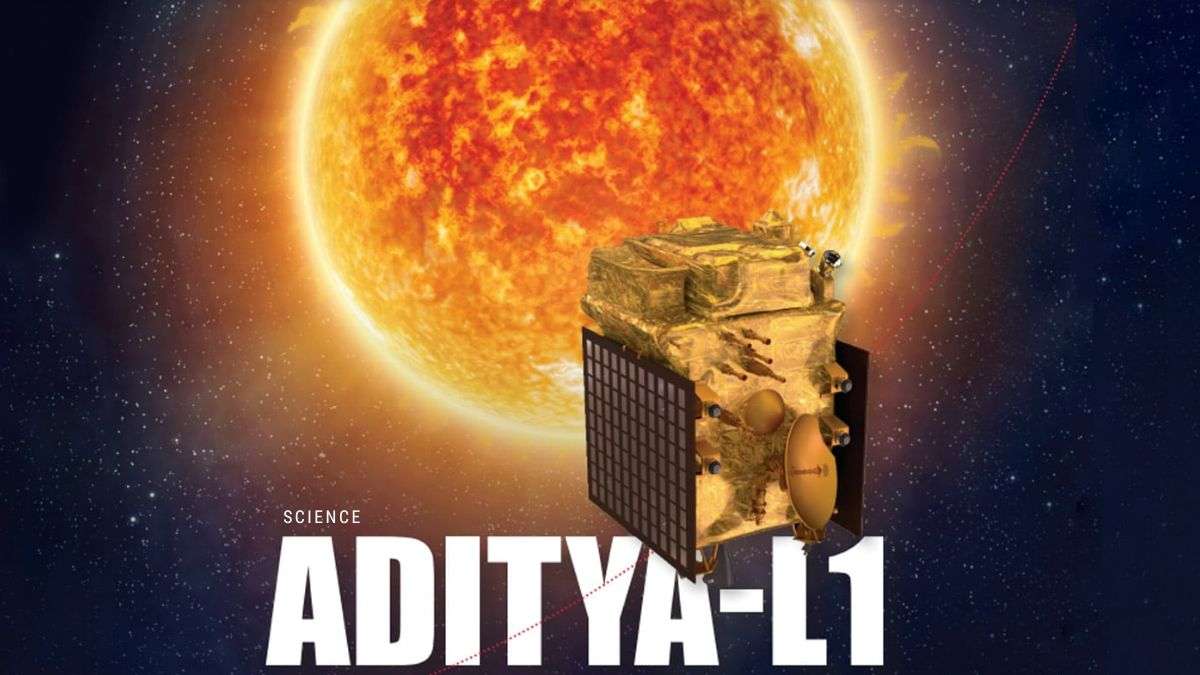
Bengaluru: India’s first solar observatory Aditya-L1, played a key role in helping scientists decode why the strongest solar storm in more than two decades that struck Earth in May 2024 behaved so unusually, ISRO said Tuesday.
Aditya-L1, which joined forces with six US satellites, including NASA’s Wind, with its precise magnetic field measurements, helped researchers to study the rare event simultaneously from multiple vantage points in space, it said.


According to a statement from ISRO, the solar storm, now called “Gannon’s storm”, which disturbed Earth’s environment severely, involved a series of giant explosions on the Sun, known as coronal mass ejections (CMEs). These CMEs are massive bubbles of hot gas and magnetic energy thrown out from the Sun into Space.
When these bubbles hit Earth, they can shake our planet’s magnetic shield and cause serious trouble for satellites, communication systems, GPS, and even power grids, the country’s space agency said.
In this regard, the space agency said that a team of Indian scientists has published a breakthrough study in the Astrophysical Journal Letters that possibly explains why the strongest solar storm which struck Earth in May 2024 in more than two decades behaved so unusually.
“During the May 2024 solar storm, scientists discovered something unusual–the Sun’s magnetic fields, which are like twisted ropes inside a solar storm, were breaking and rejoining within the storm,” ISRO said.
According to the space agency, usually, a CME carries a twisted “magnetic rope” that interacts with Earth’s magnetic shield as it approaches Earth.
But this time, two CMEs collided in space and squeezed each other so firmly that the magnetic field lines inside one of them snapped and rejoined in new ways, a process called magnetic reconnection.
This sudden reversal of the magnetic field made the storm’s impact much stronger than expected. Satellites also detected particles suddenly speeding up, indicating an increase in their energy, confirming the magnetic reconnection event, it stated.
“For the first time, researchers could study the same extreme solar storm from multiple vantage points in space. Thanks to precise magnetic field measurements from India’s Aditya-L1 mission, scientists were able to map this reconnection region,” ISRO said.
The space agency said the researchers found that the area where the CME’s magnetic field was tearing and reconnecting was enormous–about 1.3 million km across, i.e, nearly 100 times the size of Earth.
“It was the first time such a giant magnetic breakup and rejoining had ever been seen inside a CME,” it said.
“This discovery matters because it enhances our understanding of how solar storms evolve as they travel from the Sun to Earth. This demonstrates India’s growing leadership in global space science. With Aditya-L1’s contributions, India is now better prepared to understand and predict powerful solar storms,” ISRO added.
Aditya L1 was the first space-based Indian mission to study the Sun, and was launched in September 2023.