
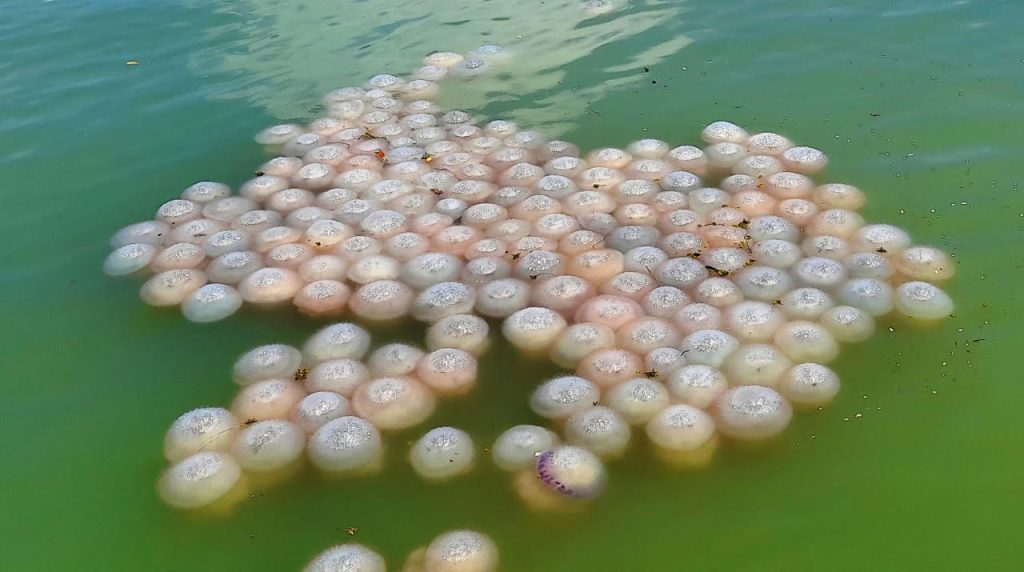
Bhubaneswar: Marine biologist Debasish Mahapatro has recorded the first-ever bloom of the jellyfish species Lobonemoides gracilis Light, 1914 in Indian waters, only the second such sighting in Asia. The large swarming event was observed along Odisha’s ecologically sensitive Gahirmatha coast between September 27 and 28, 2022, a region famed as the world’s most important mass nesting site for Olive Ridley sea turtles.
The bloom, spanning nearly 20 sq/km, featured dense clusters of 200 to 700 jellyfish, making it one of the region’s most extensive aggregations. The findings were recently presented at the first International Conference on Sustainable Green Frontiers (SGF-2025) at KIIT University in Bhubaneswar.
Mahapatro noted that while gracilis Lighth had been reported sporadically from Palk Bay and Chennai, it had never reached bloom-level intensity in India. Previously, large-scale occurrences were known only from Bangladesh, making Odisha’s event a significant addition to global marine records.
He attributes the bloom to a mix of climate-driven and human-induced factors, including rising sea surface temperatures, nutrient loading from agricultural runoff, sewage-driven eutrophication, pollution near major ports, overfishing and the decline of natural predators. He also cites cyclone-induced water mixing, frequent algal blooms with high plankton availability, shifts in salinity and coastal currents, and the loss of mangroves and other habitat alterations as contributing triggers.
Water samples showed dense phytoplankton and zooplankton populations, confirming nutrient-rich conditions favourable for jellyfish proliferation. Specimens collected using bongo nets displayed distinct morphological traits: an umbrella width of 50 cm, body length of 72 cm, and 13 to 15 rhopalia.
Taxonomic confirmation, based on global reference literature and the WoRMS database, officially adds L. robustus to the list of 14 jellyfish species in the Indian seas known to form blooms.
Although the species is non-toxic, sudden bloom events can significantly impact marine ecosystems and coastal livelihoods. They can clog fishing nets, compete with fish larvae and affect commercial fish stocks, degrade water quality as they decompose, disrupt tourism, obstruct cooling-water intakes at power plants, and alter food-web dynamics.
Researchers also believe the bloom may be ecologically linked to the annual Olive Ridley turtle congregation, as turtles feed on jellyfish. The timing suggests a possible sequential ecological chain: phytoplankton-jellyfish-turtles.
Since Lobonemoides gracilis Light is edible, experts see potential to develop jellyfish-based fisheries, common in Southeast Asia, to support coastal livelihoods. They also stress the need for continuous monitoring and early-warning systems.
This rare bloom highlights the urgency of strengthening marine management as Odisha balances biodiversity conservation with sustainable fisheries. A research article based on these findings has been published in the National Academy of Sciences Letters.