
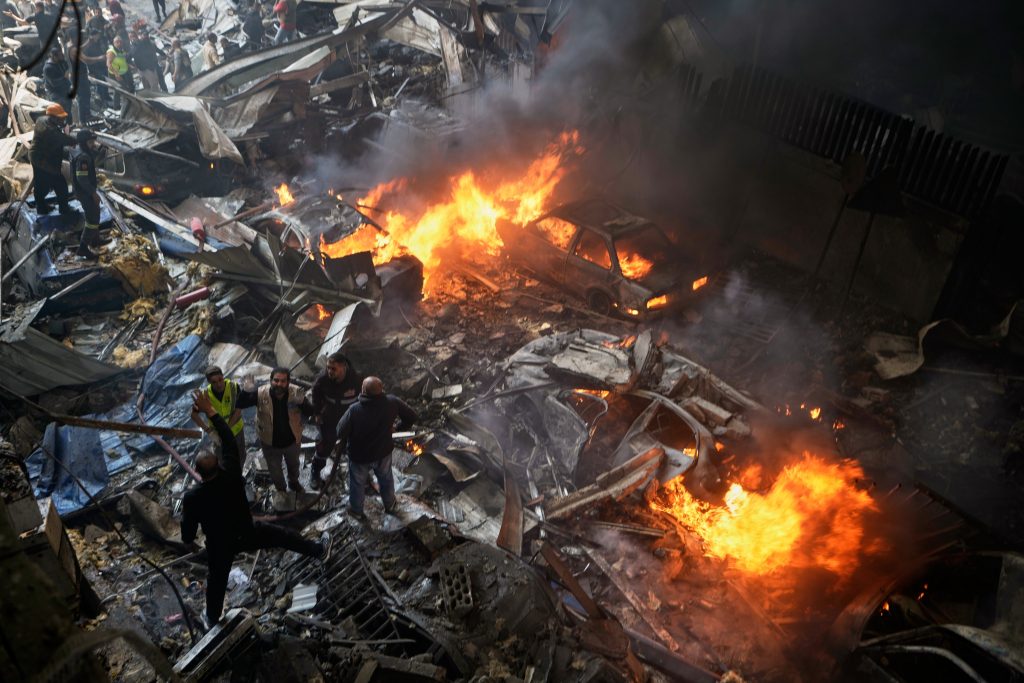
Beirut: Israeli strikes hit several dense commercial and residential areas in central Beirut without warning Wednesday afternoon, hours after a ceasefire was announced in the US-Israeli war with Iran. Lebanon’s health ministry said at least 89 people were killed and 700 were wounded.
US President Donald Trump told PBS NewsHour that Lebanon was not included in the deal because of the Lebanese militant Hezbollah group. When asked about Israel’s latest strikes, he said, “That’s a separate skirmish.” Israel had said the agreement does not extend to its war with the Iran-backed Hezbollah, although mediator Pakistan said it does.
The fleeting sense of relief among Lebanese after the ceasefire announcement turned into panic with what Israel’s military called its largest coordinated strike in the current war, hitting more than 100 Hezbollah targets within 10 minutes in Beirut, southern Lebanon and the eastern Bekaa Valley.
Black smoke towered over several parts of the seaside capital, where a huge number of people displaced by war have taken shelter. Explosions interrupted the honking of traffic on what had been a bustling, blue-sky afternoon. Ambulances raced toward open flames. Apartment buildings were struck.
Associated Press journalists saw charred bodies in vehicles and on the ground at one of Beirut’s busiest intersections in the central Corniche al Mazraa neighbourhood, a mixed commercial and residential area. Using forklifts, rescue workers removed smouldering debris and sifted through ruins for survivors.
There was no sign of Hezbollah launching strikes against Israel in the first couple of hours after the attacks.
A deadly midday barrage
Central Beirut has been targeted before, but not by so many strikes at once and in the middle of the day. Israel had rarely struck central Beirut since the outbreak of the latest Israel-Hezbollah war March 2, but has regularly struck southern and eastern Lebanon and Beirut’s southern suburbs.
Lebanon’s Minister of Social Affairs, Haneed Sayed, in an interview with The Associated Press, condemned Israel’s wide range of strikes, calling it a “very dangerous turning point.”
“These hits are now at the heart of Beirut … Half of the sheltered (internally displaced people) are in Beirut in this area,” she said, adding that she had just driven by areas hit.
She said Lebanon’s government is ready to enter into negotiations with Israel for an end to hostilities, an offer that the Lebanese president previously made. Israel has not responded. “There are calls and efforts being made as we speak,” Sayed said.
Prime Minister Nawaf Salam, in a statement, accused Israel of escalating at a moment when Lebanese officials were seeking to negotiate a solution, and of hitting civilian areas in “utter disregard for the principles of international law and international humanitarian law – principles it has, in any case, never respected.”
Lebanese President Joseph Aoun called the Israeli attacks “barbaric.”
Israel’s military said it had targeted missile launchers, command centres, and intelligence infrastructure. It accused Hezbollah fighters of trying to “blend into” non-Shiite Muslim areas beyond their traditional strongholds.
Residents and local officials denied that the buildings hit were military sites.
“Look at these crimes,” said Mohammed Balouza, a member of Beirut’s municipal council, at the scene of a strike in Corniche al Mazraa. An apartment building behind a popular shop selling nuts and dried fruit had been hit. “This is a residential area. There is nothing (military) here.”
An Israeli warning and a defiant Hezbollah
As the smoke rose Wednesday, Israeli Defence Minister Israel Katz warned Hezbollah leader Naim Kassem that “his turn will come.” In 2024, Israel killed Hezbollah’s previous leader, Hassan Nasrallah, with an airstrike.
Katz called Wednesday’s strikes the largest blow against Hezbollah since the attack that caused pagers used by hundreds of its members to explode almost simultaneously in September 2024.
Before the new strikes, a Hezbollah official told the AP that the group was giving a chance for mediators to secure a ceasefire in Lebanon, but “we have not announced our adherence to the ceasefire since the Israelis are not adhering to it.” He spoke on condition of anonymity because he was not authorised to comment publicly.
The Hezbollah official said the group will not accept a return to the pre-March 2 status quo, when Israel carried out near-daily strikes in Lebanon despite a ceasefire being nominally in place since the last full-blown Israel-Hezbollah war ended in November 2024.
“We will not accept the Israelis behaving as they did before this war with regard to attacks,” he said.
Hezbollah had fired missiles across the border days after the United States and Israel attacked Iran Feb. 28, sparking a regional war. Israel responded with widespread bombardment of Lebanon and a ground invasion.
The Israeli military chief of staff, Lt Gen. Eyal Zamir, said the attacks are to protect Israel’s northern residents, who have come under heavy fire.
Since the war started and before Wednesday’s attacks, Israeli airstrikes have killed more than 1,530 people in Lebanon, including more than 100 women and 130 children. The Israeli military has said it has killed hundreds of Hezbollah fighters. More than 1 million people have been displaced in Lebanon.
Early Wednesday, after the Iran ceasefire was announced and before Israel struck, many displaced people sleeping in tents on the streets of Beirut and the coastal city of Sidon had begun packing their belongings in preparation to return home.
Families at a sprawling displacement camp on Beirut’s waterfront later expressed confusion and despair.
“We can’t take this anymore, sleeping in a tent, not showering, the uncertainty,” said Fadi Zaydan, 35. He and his parents had prepared to head back to the southern city of Nabatieh.