
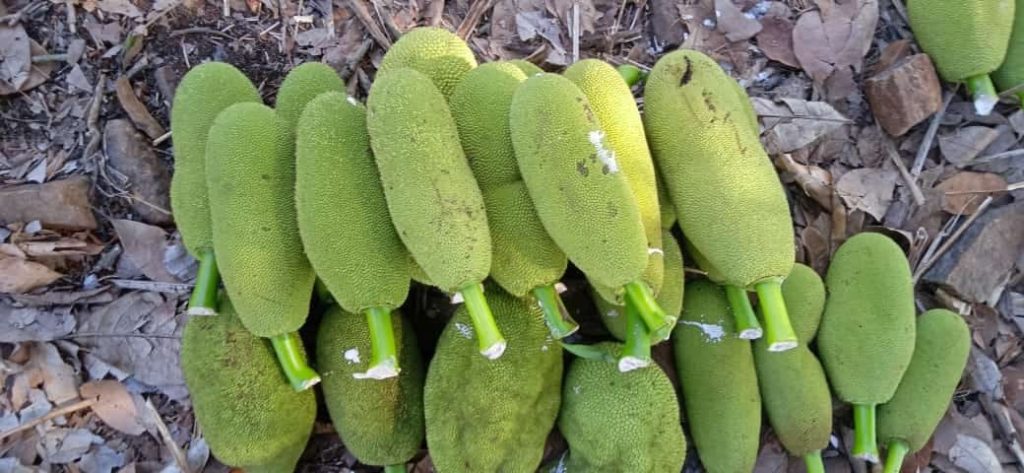
Nandapur: A state initiative to promote jackfruit processing and marketing in southern Odisha appears to have faltered in Koraput district, where the absence of organised markets, processing units and official support has left farmers dependent on middlemen who buy the fruit at low prices and transport it to other states.
Tender jackfruit grown in villages and forest areas across the district is in high demand outside Odisha. Traders are purchasing the fruit from farmers for about Rs 30-35 per piece and shipping truckloads to Chhattisgarh, Andhra Pradesh, Bihar, Maharashtra, West Bengal and Kerala, according to officials and local traders.
Koraput’s wild jackfruit is valued for its nutritional content, including vitamins A, B6 and C, as well as calcium, potassium, iron, folic acid, thiamine and niacin.
Also Read: State to develop its own jackfruit brand: Deputy CM
Despite this demand, the lack of structured marketing systems and food-processing units has prevented farmers from receiving better returns, sources said.
Data from the district Horticulture and Forest departments show that jackfruit cultivation spans about 988 hectares across Koraput, with an estimated annual production of more than 25,000 metric tonnes.
Among the blocks, Lamtaput accounts for about 101 hectares, producing roughly 2,299 metric tonnes, followed by Nandapur with 99 hectares, yielding about 2,023 metric tonnes.
Semiliguda produces around 2,196 metric tonnes from 91 hectares, while Pottangi grows about 2,295 metric tonnes across 94 hectares.
Narayanpatna records about 2,103 metric tonnes from 89 hectares. Other producing blocks include Boipariguda with about 2,090 metric tonnes from 89 hectares; Koraput block with about 1,596 metric tonnes from 65 hectares; Dasmantpur with about 1,510 metric tonnes from 76 hectares; Laxmipur with about 1,429 metric tonnes from 71 hectares; and Borigumma producing about 1,245 metric tonnes from 55 hectares.
Smaller production areas include Kundura with about 1,065 metric tonnes from 49 hectares, Kotpad with about 959 metric tonnes from 42 hectares, Bandhugaon with about 896 metric tonnes from 35 hectares and Jeypore with about 689 metric tonnes from 32 hectares.
Farmers say the fruit’s economic potential remains largely untapped because there is little government support for procurement, processing or value addition.
Agencies such as Mission Shakti, the Odisha Rural Development and Marketing Society (ORMAS), the Tribal Development Cooperative Corporation of Odisha Ltd. (TDCCOL), the State Livelihood Mission and the Regulated Market Committee operate in the district, but growers say forest and agriculture produce like jackfruit receive limited attention.
The state government had launched a Jackfruit Mission several years ago to promote products such as chips, pickles, cooked dishes and flour made from jackfruit seeds. However, farmers say there has been little follow-through locally. Discontent has also surfaced after jackfruit promotion was reportedly absent during the 29th district cultural festival, ‘Parab’. Wild jackfruit plays a crucial role in the livelihoods of tribal communities in the district.
Farmers allege that middlemen often buy rights to jackfruit-bearing trees well before harvest, limiting growers’ profits.
Although the fruit begins ripening between December and January, it largely disappears from local markets by March. More than 1,785 women’s self-help groups operate in Nandapur block alone under Mission Shakti, while the district has over 30,000 such groups.
Local stakeholders say these groups could support small processing units to produce jackfruit-based foods and create jobs.
Community leaders and farmers have urged the state government and district administration to strengthen the Jackfruit Mission and create sustainable livelihood opportunities by promoting the processing and marketing of locally grown jackfruit.