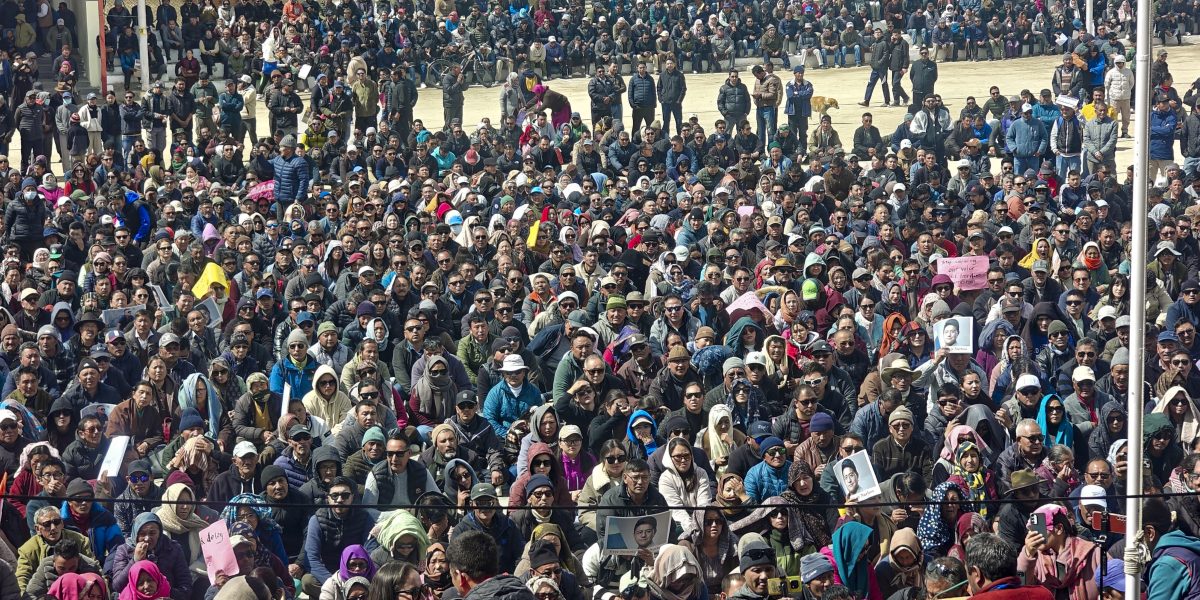
Protests by thousands of pro-democracy activists in Leh and Kargil districts on 16 March, demanding, among other things, statehood for Ladakh and the Sixth Schedule status soon after the release of the face of the movement – Sonam Wangchuk – show people’s legitimate aspirations cannot be suppressed by repression and use of laws that are wrongful and anti-people. Leaders of the Leh Apex Body (LAB) and the Kargil Democratic Alliance (KDA) took to the streets, mobilising tens of thousands of people after a pause of six months when their agitation had been stopped with an iron hand. The last major round of protests in September 2025 had turned violent, leading to clashes with security forces. Four people were killed when security personnel opened fire on unarmed citizens. Wangchuk had been arrested under the draconian NSA after being charged with exhorting the agitators to wage war against the State. Both Wangchuk and his wife Gitanjali J Angmo denied the allegation and called into question the evidence adduced against him.
The Supreme Court was to watch on 17 March the purported videos of his speech used by the prosecution to incarcerate him. But the Centre revoked the charge under NSA and set him free before the hearing. This only lent credence to the plea taken by Wangchuk and his supporters that the evidence was doctored. This backtracking by the Central government also showed chinks in the armour of the Establishment which has, of late, become unprepared to face deep scrutiny. While lifting the NSA against Wangchuk, the Union Home Ministry iterated that it remained committed to providing “all necessary safeguards” for Ladakh. But it failed to convince the agitators about its sincerity to “resolve” their grievances through constructive engagement and dialogue, “including through the High-Powered Committee and other appropriate platforms.” The agitation for Ladakh’s statehood is in a sense unique since Moslems and Buddhists residing in the region joined hands to realise their demands for statehood, better livelihood opportunities and government jobs. They have come to the conclusion that as long as Ladakh remains a Union Territory, their aspirations will not be met and they will be denied proper representation in legislative matters.
Also Read

Ladakh became a separate Union Territory in August 2019, following the abrogation of Article 370 and the bifurcation of the former state of Jammu and Kashmir. While the move initially drew support in Leh, including from Wangchuk, residents soon voiced concerns over what they described as a political vacuum under the Lt Governor’s arbitrary administration. This discontent led to a series of protests and hunger strikes, prompting political and religious groups from Buddhist-majority Leh and Moslem-majority Kargil to form a rare joint front – the LAB and the KDA. The Centre set up a high-level committee to examine Ladakh’s demands, and multiple rounds of talks were held that remained inconclusive.
Fed up with the government’s dilatory tactic and buoyed over the release of Wangchuk, the two outfits resumed their protests to press the government to restart meaningful talks so that the democratic and constitutional rights of people of Ladakh are restored. It appears the Centre had a myopic vision when it scrapped Article 370 and bifurcated the former state of Jammu & Kashmir.
In order to fulfil the ruling BJP’s old core political agenda of removing the former state’s special status, it has complicated matters. Despite its promise, it is still dillydallying with granting statehood to the Union Territory of J&K, whereas it is faced with the statehood demand of the people of Ladakh, a consequence of the abrogation of Article 370 the government apparently did not foresee. This is a prime case that shows how the old beliefs of the BJP are, in reality, not actionable and impractical. The agitators have made it clear that their commitment to the peaceful resolution of the problems is beyond question. At the same time, they are not prepared to forgo their right to protest and resort to peaceful democratic movements to realise their justified demands.
The new Lt Governor VK Saxena is wrong to assert that there is “no space for agitation and violence.” The two outfits spearheading the agitation said they would not shun the democratic path of peaceful protest, indirectly rejecting Saxena’s comment. The BJP’s gamble over abrogation of Article 370 has not paid off as it had calculated. It has failed to win the election in J&K and is delaying granting promised statehood to it. It is now faced with the problem of the demand for a new state for Ladakh. It would do well to stop prevaricating and listen to the voice of the people.