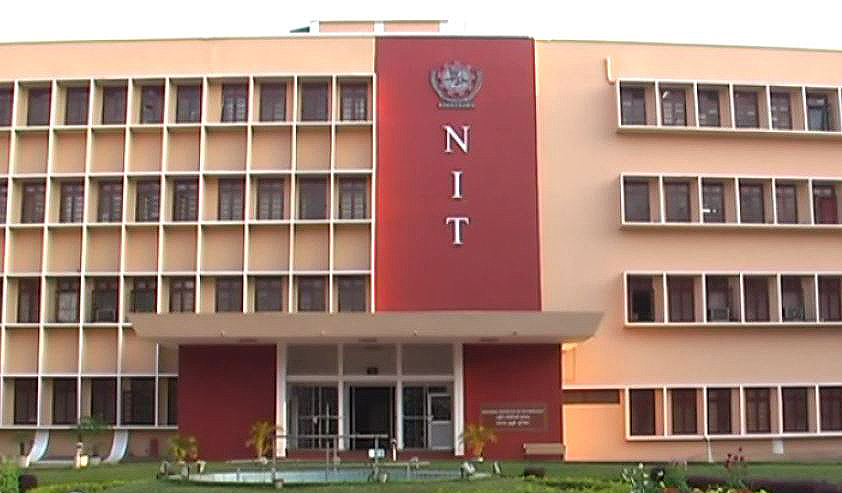
Rourkela: Researchers at the National Institute of Technology (NIT), Rourkela, have developed an innovative, nature-based wastewater treatment system aimed at revitalising India’s traditional ‘dhobi ghats’ while protecting urban water bodies from severe pollution.
The research team, led by Prof. Kasturi Dutta, Associate Professor in the Department of Biotechnology and Medical Engineering, along with Divyani Kumari (PhD) and Karthika Shanmugam (M.Tech), has created a Constructed Wetland– Microbial Fuel Cell (CW-MFC) System designed specifically to treat highly contaminated laundry wastewater.


Dhobi ghats continue to play a vital socio-economic role in many Indian cities. However, the availability of freshwater has sharply declined due to water scarcity, drying borewells, and increasing urban consumption.
At the same time, untreated laundry wastewater, laden with detergents, dyes, and microfibers, flows into rivers, lakes, and wetlands, further degrading urban ecosystems.
Also Read: NIT-R improves QS World University Ranking
To address this growing challenge, the NIT Rourkela team engineered a low-cost, chemical-free, and energy-independent treatment solution that integrates wetland plants, layered natural filters, and electricity-producing microorganisms.
The system uses nature-inspired purification mechanisms to remove pollutants while simultaneously generating bioelectricity. As a pilot initiative, the system was deployed at NIT Rourkela’s own dhobi ghat, which generates about 1,400 litres of detergent-rich wastewater daily.
The treatment unit successfully reduced surfactants and chemical oxygen demand (COD) to within permissible limits (1 ppm) as prescribed by the Bureau of Indian Standards.
The system comprises two cylindrical constructed wetland units coupled with a microbial fuel cell.
Each unit contains layers of gravel, sand, and soil, with graphite chunks placed strategically as anodes and cathodes.
The units are planted with Canna spp., a locally available wetland plant known for its resilience and pollutant uptake ability.
Wastewater is collected in an overhead tank and processed through the system, yielding colourless, odourless water suitable for reuse in washing.
Highlighting the impact, Prof. Dutta said, “Our system employs natural materials like gravel, sand, soil, plants, and microbes to purify wastewater.
It is inspired by nature and engineered for clean water.” She also acknowledged support from the Higher Education Funding Agency under its corporate social responsibility initiative.