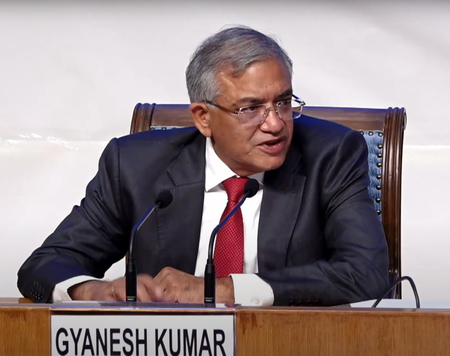
New Delhi: Signatures have been collected for a notice seeking a motion for the removal of Chief Election Commissioner Gyanesh Kumar on the ground of “partisan and discriminatory conduct in office”, among other charges, sources said.
The notice is likely to be submitted to both Lok Sabha and Rajya Sabha in a day or two, the sources added.


According to a highly placed source, seven charges are listed against the CEC in the notice, and they range from “partisan and discriminatory conduct in office” to “deliberate obstruction of investigation of electoral fraud” and “mass disenfranchisement” among others.
A senior MP familiar with the developments said they have finished collecting signatures, and the notices are more likely to be submitted Thursday.
Another senior opposition leader said the notice might be submitted Thursday or Friday in both Houses.
Around 120 MPs have so far signed the notice to be submitted in the Lok Sabha, and around 60 MPs have signed the notice to be submitted in the Upper House, the sources added.
According to rules, at least 100 MPs must sign a notice seeking the removal of the CEC in the Lok Sabha, and the required strength in the Rajya Sabha is 50.
The notice has been signed by members from all the Indian bloc parties, the sources added.
MPs from the Aam Aadmi Party (AAP), which is no longer officially part of the bloc, have also signed the notice, another source said.
This is the first time a notice has been given seeking the removal of the CEC.
Opposition parties have accused the CEC of aiding the ruling BJP on several occasions, especially over the ongoing Special Intensive Revision (SIR) exercise, which they have alleged is aimed at helping the ruling party at the Centre.
Concerns have especially been expressed over the conduct of the exercise in West Bengal, with Trinamool Congress (TMC) supremo and Chief Minister Mamata Banerjee accusing the poll panel of deleting genuine voters.
The process for removing the CEC is similar to that for the removal of a Supreme Court or high court judge, and only grounds of proven misbehaviour or incapacity can lead to impeachment.
A motion for removal may be introduced in either House of Parliament and must be passed by a special majority — a majority of the total membership of the House and a two-thirds majority of the members present and voting.
According to the law on the appointment of CEC and election commissioners, “CEC shall not be removed from his office except in the like manner and on the like grounds as a judge of the Supreme Court”, and the other election commissioners shall not be removed from office “except on the recommendation of the CEC”.
According to the Judges (Inquiry) Act, 1968, if the notices for the motion are given on the same day in both Houses of Parliament, no committee shall be constituted unless the motion has been admitted in both Houses. After the motion has been admitted in both Houses, a committee shall be constituted jointly by the Speaker and the chairman.